



Navigating Italy's Rail Network
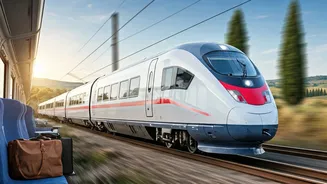
Italy boasts an extensive and efficient rail system, making train travel a prime choice for exploring the country. High-speed services like Frecciarossa
and Frecciargento, operated by Trenitalia, alongside the privately-run Italo trains (AGVs and EVOs), connect major cities such as Turin, Milan, Bologna, Florence, Rome, Naples, and Salerno. These high-speed lines drastically cut travel times; for instance, the Rome-Naples route takes just over an hour, and Rome-Milan is under three hours, with frequent departures. For journeys reaching further south, including Reggio Calabria, or along the east coast to Ancona, Pescara, Bari, and Lecce, Trenitalia's Frecci trains are the primary option. Beyond these fast routes, Intercity and regional trains, known as 'Regionales', serve the remainder of the country, including Sicily and Sardinia. These trains, often featuring updated rolling stock like double-decker carriages, maintain a good standard of repair, ensuring comfortable travel. While most sizable towns are accessible by train, certain areas like the Amalfi Coast, rural Calabria and Basilicata, and large parts of Sardinia may require a switch to bus services for final access.
Tickets, Reliability & Strikes
Purchasing train tickets in Italy is straightforward. Multilingual ticket machines, termed 'biglietto veloce,' are available at all stations and accept cash or credit cards; larger stations also have ticket clerks. While trains can get busy, especially during peak seasons, finding a seat is generally not an issue unless disruptions occur. Booking high-speed (AV) train tickets in advance can yield savings of up to 50%, but these bookings are typically non-refundable. It's crucial to note that regional train tickets not pre-dated must be validated by stamping them in the green and grey 'convalida' machines located on station platforms before boarding; failure to do so can result in a fine of around €50. Tickets for AV and Intercity trains do not require validation as they are specific to a designated service. Regarding reliability, while Italian trains are generally on time, minor delays of 10 to 20 minutes are not uncommon, particularly on regional services, which can impact tight connections. Travelers should also be aware of 'scioperi' (strikes), a recurring aspect of Italian public transport that can cause significant disruptions, though these are usually announced several days in advance.
Seating, Classes & Passes
When it comes to seating, ticket prices and options vary significantly based on train type, service class, travel time, and booking advance. The premium Frecciarossa trains offer four classes: Standard, Premium, Business, and Executive, with progressively higher fares. Italo trains provide three classes: Smart, Prima, and Club, mirroring the premium offerings of Frecciarossa. For Trenitalia's other services, first- and second-class seating are available, with first class typically costing a third to half more. For high-speed and Intercity services, seats are assigned upon booking, which can be made up to four months in advance, though trains rarely sell out due to their frequency. Regional trains, which stop at numerous stations, do not require reservations; passengers can board and select any available seat. For long-term visitors or residents, Trenitalia offers discount passes like the Green Card (for those aged 12-26) and Silver Card (for over-60s). For shorter trips, InterRail and Eurail passes are options, with various global and one-country passes available. However, it's important to note that neither InterRail nor Eurail passes are valid on Italo trains, and a reservation fee of approximately €13 is still required for high-speed journeys with these passes. Often, purchasing individual tickets in advance, especially for regional trains, can be more economical than using a pass.
International & Scenic Journeys
Italy's rail network extends beyond its borders, offering captivating international routes. The scenic Brenner Pass route, connecting Munich with Venice over the Alps, is a highlight, as is the Euronight service from Rome to Vienna, featuring two-bed sleepers. For a luxurious experience, the Venice Simplon-Orient-Express offers an opulent journey from London or Paris to Venice. Since 2021, Frecciarossa trains have facilitated rapid connections between Milan and Paris, and Milan and Turin. It is possible to travel from Milan to London in a single day for around €85 by combining Frecciarossa and other services, or to Paris for as little as €30, while enjoying stunning alpine scenery. For those seeking the most picturesque experiences within Italy, it's often necessary to opt for regional routes or smaller private lines, as high-speed trains can render the landscape a blur. Notable scenic routes include the Centovalli Railway from Domodossola to Locarno, Sardinia's historic narrow-gauge lines, the Circumetnea Railway around Mount Etna in Sicily, the coastal journey between La Spezia and Genoa on the Levante Riviera, and the Circumvesuviana line connecting Naples to Sorrento, offering views of Mount Vesuvius and the Bay of Naples.
Onboard Amenities & Services
Train travel in Italy prioritizes passenger comfort and convenience, with ample provisions for luggage, food, and connectivity. There are no specific luggage charges, and passengers are permitted to bring whatever they can manage onboard, with luggage racks and tables readily available. Assembled bicycles can be transported on regional and Intercity trains for a supplement of €3.50, while disassembled bikes are allowed on AV trains free of charge. Dining options vary; Frecciarossa trains feature a staffed café-bar called the Freccia Bistrò, and offer meal boxes in higher classes. Other trains, including Italo and Trenitalia's regional and Intercity services, are equipped with vending machines. Many stations also offer cafés for purchasing snacks and sandwiches. Staying connected is generally easy, with charging points for phones and laptops available on most trains, though their functionality can vary. Freccia and Italo trains also provide free Wi-Fi. Toilets are standard on most trains, typically well-maintained and more spacious than airplane bathrooms. However, it's advisable to carry your own toilet paper and hand sanitizer as a precaution. Accessible travel is also a priority, with designated wheelchair spaces and accessible toilets on AV trains, complemented by braille signage and ramps in stations. Specialized 'Sala Blu' offices at 15 major stations offer assistance to travelers with disabilities, including the visually impaired and pregnant individuals.