

The Data Deluge
Our digital world is expanding at an astonishing rate, with an ever-increasing volume of photos, emails, research, and AI models being generated annually.
This exponential growth places immense pressure on existing storage technologies, particularly as artificial intelligence systems demand ever-larger datasets to function and evolve. The fundamental challenge lies not just in storing this data, but in ensuring its long-term accessibility and integrity, as traditional media inevitably succumbs to degradation over time, necessitating constant migration and backup.
Project Silica's Vision
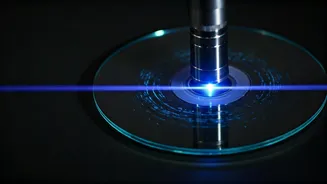
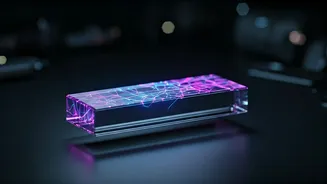
Microsoft's research division, known as Project Silica, has unveiled a groundbreaking method that could fundamentally alter how we preserve digital information. By employing ultra-fast lasers, they are able to write data directly into solid pieces of glass, creating a storage medium with an astonishing projected lifespan of up to 10,000 years. This innovative technique aims to eradicate the persistent problem of 'data rot' – the gradual decay of storage media – and eliminate the ongoing, resource-intensive task of transferring data to new formats every few years.
Laser-Etched Data
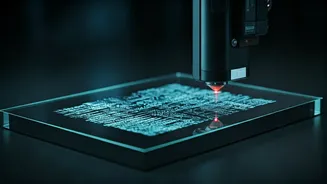
The process of inscribing data onto glass is remarkably precise, utilizing femtosecond laser devices that emit pulses lasting just one quadrillionth of a second. These lasers are capable of making minuscule modifications within the glass material itself, without affecting its surface integrity, much like delicate surgical instruments. Rather than storing data in traditional flat bits, this method creates three-dimensional structures, termed 'voxels,' deep within the glass. These microscopic alterations, akin to three-dimensional pixels, represent the embedded digital information, offering a robust and enduring form of storage.
Affordable Materials
A significant advancement in Project Silica's development involves the use of 'phase voxels' and a shift to more cost-effective materials. Initially, the research relied on expensive fused silica glass. However, recent breakthroughs have led the team to adopt borosilicate glass, a material renowned for its durability and commonly used in everyday kitchenware. This transition dramatically reduces the overall cost of the storage medium, making the technology more viable for widespread adoption and application.
Retrieval Mechanism
The retrieval of data from these glass archives is managed through sophisticated automated systems. Robotic arms are employed to fetch specific glass pieces from storage, after which a specialized neural network scans and interprets the encoded patterns. Crucially, this system requires power only when data is being accessed, not for its long-term preservation. This efficiency, combined with the inherent durability of glass, offers a sustainable solution for safeguarding information across vast timescales, resistant to heat, humidity, and electromagnetic interference.
Real-World Applications
The viability of this technology has already been demonstrated through successful pilot projects. In 2019, the iconic 'Superman' film from 1978 was flawlessly stored within a small glass sample. Furthermore, the technology is being implemented in Norway's Svalbard region for the Global Music Vault, an initiative dedicated to preserving musical recordings for future generations. The robustness of glass against physical damage and environmental factors, coupled with its longevity, positions it as a potentially superior and more sustainable alternative to current digital storage methods.
Future of Archiving
The widespread commercialization of this laser-engraved glass storage could profoundly transform how governments, institutions, and corporations manage their most critical documents and historical records. In an age where digital information serves as the bedrock of our history, scientific progress, and cultural heritage, the ability to preserve it intact for millennia moves from the realm of speculation to a tangible reality, ensuring that our digital legacy endures far beyond the lifespan of current technologies.