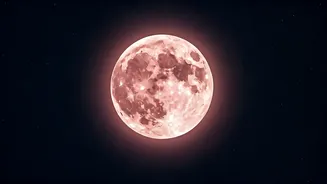







Lunar Illumination Explained
The culmination of April's full moon on April 1, 2026, is a fascinating interplay of lunar orbital mechanics and historical traditions. Contrary to its
vibrant name, the "Pink Moon" won't visually transform into a rosy hue. Its designation is rooted in the scientific principles governing the Earth, Moon, and Sun's alignment, alongside seasonal plant blooms in the Northern Hemisphere. For astronomers, this specific full moon presents a prime opportunity to study the distinctions between observing celestial bodies at opposition and precisely measuring the subtle variations of the Moon's perigee. This alignment, known as syzygy, occurs when the Moon is precisely 180 degrees opposite the Sun in our sky, and simultaneously at its furthest point from the Sun in its orbit, with Earth positioned directly between them. This celestial arrangement allows sunlight to fully illuminate the lunar face visible from Earth. NASA highlights the significance of this 2026 event, noting its proximity to the vernal equinox, which influences the Moon's axial tilt and subsequently affects how sunlight reflects off its surface, known as regolith. Furthermore, an 'opposition surge' phenomenon will be observable, making the Moon appear exceptionally luminous due to the absence of crater shadows, a consequence of our viewing angle from Earth.
The Pink Moon Myth
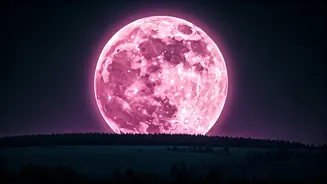
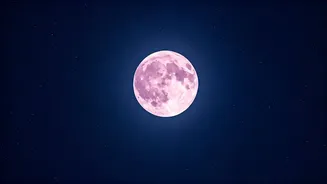
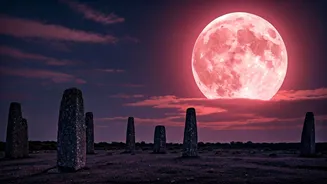
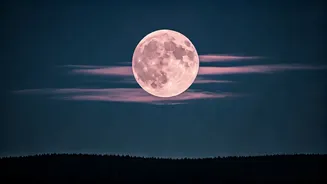
The 'Pink Moon' name holds no visual promise of a pink celestial body; its origin lies in indigenous traditions and early botanical observations. The Algonquin tribes first bestowed this name, later documented in the Old Farmer's Almanack, to signify the blooming of *Phlox subulata*, commonly known as moss pink, a flower that heralds the early spring in the Northern Hemisphere. However, there is a scientific reason why the Moon *can* appear pinkish, particularly when viewed near the horizon. At this low angle, moonlight traverses a significantly thicker layer of Earth's atmosphere. This extended journey causes shorter, blue wavelengths of light to be scattered away by atmospheric particles, allowing the longer, red and pink wavelengths to penetrate through and reach our eyes, thus imbuing the Moon with a reddish or pinkish tint. This atmospheric scattering effect is a physical phenomenon independent of the Moon's actual color.
Tides and Lunar Effects
The 2026 Pink Moon occurs in close temporal proximity to perigee, the point in the Moon's elliptical orbit where it is closest to Earth. This alignment will result in a 'perigean full moon,' amplifying the gravitational influence on Earth's oceans and leading to more pronounced tidal ranges. While the most substantial 'King Tides' are anticipated during the New Moon period between April 17-21, the perigean full moon will contribute to elevated tides. King tides, characterized by unusually high tides, arise from the combined gravitational pull of both the Moon and the Sun on Earth's oceans. The moon will reach its maximum illumination at 02:12 UTC on April 2nd, which translates to 10:12 PM ET on April 1st for observers in the northern hemisphere. While the Danjon scale is typically used for lunar eclipse observations, it's not the primary method for assessing the 2026 Pink Moon's clarity; atmospheric stability, or 'seeing,' will be the determining factor in how clearly features like the Tycho crater and lunar maria are perceived.
Lunar Libration Insights
While the Moon often appears as a static disc, a unique opportunity to observe lunar libration arises during the April 2026 Pink Moon. Due to its slightly elliptical and tilted orbit around Earth, the Moon exhibits a subtle 'nodding' and 'swaying' motion observable throughout the month. This phenomenon allows astronomers, according to the US Naval Observatory, to witness approximately 59 percent of the lunar surface over the course of the night in early April. Libration enables us to see features along the Moon's far eastern limb that would otherwise remain hidden from our direct view, offering a more comprehensive perspective of its topography.
Topography at Zero Phase
The full moon's seemingly flat appearance, contrasting with a crescent moon, is related to the Opposition Effect, also known as the Seeliger Effect. The full Pink Moon occurs when the Sun, Earth, and Moon are aligned, presenting the lunar surface at a phase angle of zero degrees. Research indicates that this alignment eliminates visible shadows cast by craters on the Moon. Consequently, while the lunar surface appears brighter, the absence of shadows also diminishes the perception of three-dimensional topography. The lunar highlands, in particular, seem exceptionally luminous and uniform under these conditions, contributing to the 'flat' visual impression.
Optimal Viewing Times
The precise moment of astronomical full illumination for the 2026 Pink Moon is slated for 02:12 UTC on April 2nd. For those in the United States, this peak will be observable on the evening of Wednesday, April 1st, at 10:12 PM Eastern Time. While this exact moment signifies the astronomical full moon, the visual perception of a full moon will persist for approximately one day before and after this peak, offering a substantial window of time to admire its full brilliance. The apparent fullness will extend beyond the single moment of maximum brightness, allowing for extended observation.