
A Historic Championship
In 1965, Dinesh Khanna etched his name into Indian badminton history by becoming the nation's sole singles champion at the Badminton Asia Championships,
a remarkable feat accomplished on home soil in Lucknow. This victory wasn't just a personal triumph; it represented a significant milestone for Indian badminton, inspiring countless aspiring players. Khanna's win remains a benchmark for Indian shuttlers aiming for international acclaim, a testament to his skill and dedication. The atmosphere in Lucknow was electric, with the crowd's fervent support playing a crucial role in motivating Khanna during the closely contested final. His victory brought immense pride and galvanized a generation of athletes, solidifying his place as a legend in the sport.
The Unconventional Prize
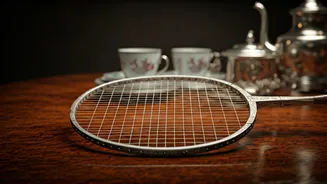
While Dinesh Khanna's 1965 Badminton Asia Championship title was a monumental achievement, the prize he received—a white metal tea set—proved to be a peculiar memento. The original rolling trophy, a symbol of his hard-won victory in Lucknow, was passed on to the next Asian champion from Indonesia, as per a proposal from a military commander at the 1969 edition in Manila to create a new trophy. Khanna, who had been an unseeded player, was left without a physical trophy to display, and even the gold medal was merely a footnote on his Wikipedia page. Years later, his wife humorously questioned the utility of the tea set, stating, 'What are we to do with the tea set? We couldn’t use it to drink tea. I couldn’t display a tea set in cabinets like a trophy. We got rid of it naturally!' This anecdote highlights the often unexpected nature of sporting rewards and the practical considerations that follow a historic win.
The Journey to Victory
Khanna's path to the 1965 Asian Championship title was far from straightforward. A civil engineering graduate, he initially played in the shadow of established players like Nandu Natekar and Suresh Goel. After a knee injury in 1963 led to open-knee surgery, he dedicated a year to badminton. His comeback included intense training with top Indian players and a three-week camp in Lucknow, where he was ranked as India's fourth-best singles player. His initial plan was modest: win a couple of matches and observe the world's best players. However, his quarter-final opponent was Yoshinori Itagaki, the 'Bouncing Ball' from Japan, known for his relentless retrieving. Khanna, a defensive player, contrasted with Itagaki's extensive physical training, famously stating he was resting while Itagaki was skipping. Despite Itagaki's fitness, Khanna's disciplined defense secured the first set 15-1. The second set was a grueling battle with rallies extending to 50 strokes. At 12-12, exhaustion set in, but Khanna strategically used his backhand to force Itagaki into tiring overhead shots, ultimately prevailing.
Semis and The Final
Following his hard-fought victory over Itagaki, Dinesh Khanna faced his compatriot Suresh Goel in the semi-finals, a player renowned for his superior strokeplay. Goel himself had eliminated the top seed, Yew Cheng Hoe, in the quarter-finals. For Khanna, reaching the finals was an unexpected turn of events, a surreal experience given his initial intention was merely to observe from the sidelines. The inspiration for his final push came from a luminary of Indian sports, KD Singh Babu, an Olympic gold medalist. Babu's handshake and good wishes before the final instilled a belief in Khanna that if an Indian could win an Olympic gold, he could certainly win an Asian Championship. Playing with newfound freedom and confidence, Khanna executed his shots with precision and length. Though he faced a momentary wobble in the second set, leading 12-7 but faltering to 12-11, advice from Nandu Natekar to vary his net play helped him secure the win. In a display of the era's sportsmanship, Khanna was reluctant to overtly celebrate, reflecting the humble ethos of the time.
Continued Dominance
Dinesh Khanna's triumph at the Badminton Asia Championships in 1965 was not a singular event; he proved it was no fluke by securing another title a week later at the Nehru Memorial tournament in Delhi, where many top players had also converged. This added victory further cemented his status in the badminton circuit, especially since he had previously only won state championships. His distinctive playing style drew commentary, with radio commentator Jasdev Singh questioning his defensive approach. Khanna's witty response, "I’m born in Gandhi-Nehru’s land, so I choose non-violence," playfully explained his strategic, less aggressive style. This period also saw the quiet resolution of the 'storm in a teacup' regarding the unconventional prize—the tea set—which eventually made way for decluttering, a decision Khanna quietly accepted.