




The Global Water Crisis
Our planet is facing an unprecedented water shortage, with the United Nations declaring a state of severe crisis. Nearly three-quarters of the global population
resides in areas suffering from water insecurity, either moderate or critical. Annually, a staggering four billion individuals endure extreme water scarcity for at least one month. This dire situation underscores the urgent need for innovative solutions to ensure access to clean drinking water for everyone, everywhere. The scarcity is driven by a confluence of factors including overuse of existing resources, widespread pollution of waterways, and the escalating impacts of climate change, all pushing our vital water systems to their breaking point.
MOFs: The Molecular Sponges
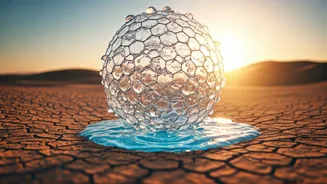
Enter the realm of metal-organic frameworks (MOFs), the groundbreaking materials developed by Nobel laureate Omar M. Yaghi. Yaghi, recognized with the Nobel Prize in Chemistry, pioneered these unique structures in 1998. MOFs are essentially intricate crystalline lattices, formed by linking metal oxides and organic components. What makes them extraordinary is their highly porous nature, creating vast internal surface areas. To illustrate, a single gram of MOF material can boast a surface area equivalent to an entire soccer field. This remarkable spongelike quality allows them to effectively capture and store gases, a property Yaghi ingeniously adapted for water acquisition.
Harvesting Water from Air
Yaghi's transformative work with MOFs now focuses on water capture, even in the most challenging environments. His research, detailed in 2020, highlighted MOFs' capability to extract water vapor from air with relative humidity as low as 10%. This is a remarkable feat, surpassing the typical humidity levels found in arid locations like California on hot summer days. Yaghi personally validated this potential by testing his technology in such conditions, proving its efficacy for widespread application. His personal motivation stems from a childhood spent in a Jordanian refugee community lacking running water, imbuing him with a deep understanding of the problem and a powerful drive to find a solution.
Containerized Water Generation
The practical application of this Nobel-winning science is being realized through Atoco, a climate technology company founded by Yaghi in 2020. Atoco is developing portable units, roughly the size of a standard 20-foot shipping container, designed to generate significant quantities of clean water. Each unit can produce up to 1,000 liters of near-distilled drinking water daily. This output is substantial, capable of meeting the daily drinking water needs of approximately 500 people, given an average daily consumption of 2 liters per person. These containerized systems can be deployed virtually anywhere, offering a decentralized and immediate solution to water scarcity.
The Absorption-Release Cycle
The ingenious mechanism behind this water generation system relies on a simple yet effective temperature cycle. As detailed in reports, during the cooler nighttime hours, the MOF material actively absorbs moisture from the surrounding air, trapping water vapor within its microscopic pores. When daylight brings warmer temperatures, the structure undergoes a transformation, releasing the captured water as potable liquid. This process requires no external infrastructure like wells or complex filtration systems. The water produced is consistently reported to be of near-distilled quality, ensuring purity and safety for consumption.
Scaling for the Future
While the science is revolutionary, the widespread implementation of this MOF technology faces current challenges, primarily related to cost and early-stage production. However, the team at Atoco is actively working on scaling up manufacturing, with plans for broader rollout anticipated by 2026. Initial deployments will target water-stressed regions and specific industries, such as data centers, which have significant water requirements. Yaghi remains resolute in his mission, emphasizing the need for global courage to adopt and expand these life-sustaining solutions. The potential impact of this innovation on global water security is immense, offering a tangible path towards a more water-resilient future.