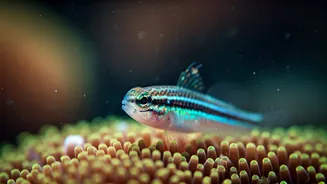







Paedocypris Progenetica's Realm
Deep within the acidic, oxygen-starved peat swamps of Southeast Asia resides the Paedocypris progenetica, a true master of near-invisibility. This minuscule
fish rarely exceeds 8 millimeters in length, its body so transparent it blends seamlessly with its surroundings. Navigating a challenging aquatic landscape where survival is a daily feat, this tiny titan achieves sexual maturity with remarkable speed, completing its life cycle in mere weeks. Its existence highlights how life can adapt and flourish even in the most unforgiving conditions, proving size is not a prerequisite for success in the natural world.
Schindleria Brevipinguis's Drift
Off the vibrant coral reefs that fringe northern Australia, a nearly imperceptible fish, Schindleria brevipinguis, makes its home. Measuring approximately 8 millimeters, this creature is so small that it could easily be overlooked, drifting serenely with the ocean currents. Its primary sustenance comes from tiny planktonic organisms, and its diminutive stature is a crucial adaptation for evading the myriad predators that populate these waters. This species exemplifies the principle that even the smallest organisms have developed sophisticated strategies to ensure their survival in a competitive marine ecosystem.
Pandaka Pygmaea's Hideaway
Hailing from the Philippines, the Pandaka pygmaea, or dwarf pygmy goby, is another miniature marvel. This species typically measures just under a centimeter and prefers the tranquil embrace of shallow, calm waters, often seeking refuge amongst aquatic vegetation and root systems. Its diet consists almost exclusively of microscopic life, and its small size combined with agility allows it to deftly evade potential threats. Despite its resilience, the dwarf pygmy goby is surprisingly sensitive to shifts in its environment, underscoring the delicate balance that even the smallest of creatures must maintain.
Paedocypris Micromegethes's Adaptation
A very close relative to the aforementioned Paedocypris progenetica, the Paedocypris micromegethes also inhabits the murky swamp environments of Southeast Asia. This species is similarly diminutive, seldom surpassing one centimeter in length. Its translucent body serves as an exceptional camouflage, rendering it almost invisible within the water. Thriving in habitats characterized by low nutrient levels and high acidity, this fish demonstrates the extraordinary adaptability of life, showing that even the most diminutive organisms can conquer extremely challenging ecological niches.
Photocorynus Spiniceps's Union
The Photocorynus spiniceps inhabits an entirely different realm: the deep, abyssal plains of the ocean. Here, visual cues are virtually nonexistent. The males of this species are incredibly small, measuring around 6 millimeters, and they employ a unique survival strategy. They attach themselves to a vastly larger female, becoming entirely dependent on her for sustenance and protection. In this pitch-black environment, survival hinges on senses beyond sight, relying on tactile and chemical signals to navigate existence. This profound symbiosis illustrates how minuscule size can be an advantageous trait in the extreme conditions of the deep sea.