








An Introduction To Turtles
Turtles are among the oldest creatures on Earth. These reptiles are easily recognized by their protective shell. Their shells consist of bony plates that
are covered by scales. The shape and size of their shell vary widely based on the turtle's species. They have adapted to live in diverse habitats, including oceans, rivers, and land. Different species of turtles have different diets. Some are herbivores, and some are carnivores, while others are omnivores. Several turtle species have been around for millions of years, adapting to change and surviving extinction events that eliminated many other species. Understanding their diversity and their role in the ecosystem is crucial for conservation efforts. They play vital roles in their habitats, such as controlling vegetation, dispersing seeds, and providing food for other animals.
Indian Roofed Turtle
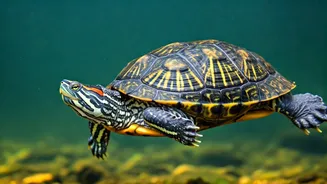
The Indian roofed turtle, scientifically known as *Pangshura tecta*, is a freshwater species, easily identifiable by its distinctive shell. They are found in rivers, streams, and lakes, particularly in the northern regions of India, Pakistan, Bangladesh, and Nepal. The roofed turtle derives its name from the appearance of its shell. This species is commonly found in slow-moving water bodies with plenty of aquatic vegetation. Adult Indian roofed turtles usually grow to around 25 to 30 centimeters in length. They are primarily omnivores, feeding on aquatic plants, insects, and small crustaceans. Conservation efforts are crucial because the roofed turtle faces threats such as habitat loss due to dam construction and pollution. Awareness and protection of their natural habitats can help ensure the survival of these unique turtles.
Indian Flapshell Turtle
The Indian flapshell turtle, scientifically known as *Lissemys punctata*, has a unique feature: a shell with flexible flaps of skin. These flaps, located on their plastron (the underside of the shell), allow the turtle to close its shell tightly for protection. Found throughout South Asia, including India, Pakistan, Sri Lanka, and Bangladesh, these turtles inhabit various water bodies, from rivers and ponds to lakes and irrigation canals. Adult flapshell turtles typically reach sizes of about 25 to 35 centimeters. This species can stay underwater for extended periods. They are omnivorous, consuming plants, fruits, insects, crustaceans, and fish. Due to habitat destruction and over-collection for the pet trade, the Indian flapshell turtle faces considerable threats. Preserving their wetland habitats is necessary to keep their populations stable.
Green Sea Turtle
The Green Sea Turtle (*Chelonia mydas*) is one of the most widely distributed sea turtle species, found in tropical and subtropical waters worldwide, including the coastal regions of India. Unlike many other sea turtles, adult green sea turtles are primarily herbivores, feeding on seagrass and algae. These turtles can grow to substantial sizes, with some individuals reaching over one meter in length. Their shells are typically smooth and vary in color, ranging from olive green to brown. Green sea turtles migrate long distances between their feeding grounds and nesting beaches. They are listed as endangered or threatened. They face threats from habitat destruction, fishing, and climate change, which affects their nesting sites and food sources. Efforts to protect their nesting sites and reduce fishing impact are critical for their conservation.
Hawksbill Turtle
The Hawksbill turtle (*Eretmochelys imbricata*) is a marine turtle, recognized by its distinctively patterned shell with overlapping scales. They are found in tropical and subtropical oceans around the world, including the Indian Ocean and coastal areas of India. These turtles are primarily found in coral reefs, where they feed on sponges and other invertebrates. Hawksbill turtles are medium-sized sea turtles, typically reaching up to 1 meter in length. Their shells are known for their beautiful patterns and colors, which have sadly led to their exploitation for the tortoiseshell trade. Hawksbill turtles are critically endangered. They face many challenges: habitat destruction, entanglement in fishing gear, and climate change. Protecting their coral reef habitats and enforcing international trade bans are essential for their survival.
Leatherback Turtle
The Leatherback turtle (*Dermochelys coriacea*) is the largest of all living turtles. Its unique shell is covered by a leathery skin rather than hard scales. These turtles are found in oceans worldwide. They travel vast distances during their migrations, including the Indian Ocean. Leatherback turtles have a diet mainly consisting of jellyfish. They can grow to massive sizes, with some individuals reaching over 2 meters in length and weighing over 900 kilograms. Their leathery skin helps them endure the cold waters they navigate. Leatherback turtles are critically endangered and face many threats: entanglement in fishing gear, plastic pollution, and destruction of nesting sites. Protecting their nesting beaches and reducing the amount of plastic pollution are key to their survival.
Olive Ridley Turtle
The Olive Ridley turtle (*Lepidochelys olivacea*) is one of the smallest and most abundant sea turtles. They are found in warm waters worldwide, and are known for their mass nesting events, called arribadas, where thousands of turtles come ashore to nest simultaneously. These turtles are widely distributed in the Indian Ocean, including the coasts of India. Olive Ridleys are named for the olive-green color of their shells. They feed on a variety of marine organisms, including crustaceans and jellyfish. These turtles are particularly known for their unique nesting behavior. While considered the most numerous of the sea turtles, they are still considered vulnerable. Conservation efforts should focus on protecting their nesting beaches and reducing bycatch in fishing operations.
Indian Tent Turtle
The Indian Tent Turtle (*Pangshura tentoria*) is a freshwater species with a distinctive shell structure. It has a slightly elevated shell that resembles a tent. They are primarily found in the rivers and lakes of the Indian subcontinent, including India, Pakistan, and Bangladesh. This species is unique for its tent-like shell structure. Their shells usually have a dark coloration with distinctive patterns. Adult Indian Tent Turtles usually reach about 20-30 centimeters in length. They are omnivores, feeding on aquatic vegetation, insects, and small fish. They face threats from habitat destruction and pollution, which makes them less in numbers. Conservation efforts are required to protect their habitats and prevent them from extinction.