






Launch and Ascent
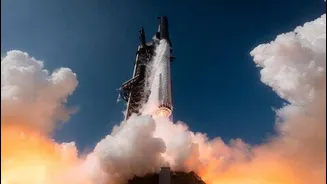
Following a brief delay due to a technical snag with a hydraulic pin on May 21st, SpaceX successfully launched its upgraded Starship V3 on the evening
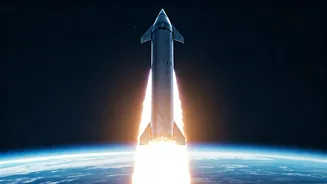
of May 22nd. The powerful rocket, equipped with 33 new Raptor 3 engines on its Super Heavy booster, lifted off from Starbase, Texas, at 6:30 PM Eastern time. During the ascent phase, one of the booster's engines unexpectedly shut down. However, the spacecraft continued its trajectory, paving the way for the critical stage separation maneuver. This initial phase of the flight was designed to validate the rocket's core launch capabilities and its ability to handle the stresses of liftoff and initial climb into space.
Booster and Ship Separation
As the flight progressed, the Super Heavy booster executed a planned directional flip, a maneuver crucial for future recovery attempts. However, the booster was unable to complete a full boostback burn, a maneuver essential for its return to the landing site. This partial burn meant the booster ultimately crashed into the Gulf of Mexico, a planned outcome as recovery was not intended for this specific test. Meanwhile, the Starship upper stage, despite also experiencing the loss of one of its six Raptor 3 engines, maintained its intended suborbital trajectory. This demonstrated the resilience of the upper stage and its ability to continue the mission even with reduced engine performance.
In-Space Operations
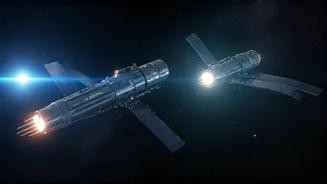
Around 30 minutes after the initial liftoff, the Starship upper stage successfully deployed its payload, which included 20 Starlink simulators and two specially modified Starlink satellites. These modified satellites were positioned to capture unique imagery of the Ship in space, providing valuable visual data. This phase of the mission validated the deployment mechanisms for future satellite constellations and demonstrated the spacecraft's capability to carry and release payloads effectively. The data collected from these in-space operations is vital for refining future mission planning and understanding spacecraft behavior in the vacuum of space.
Re-entry and Landing
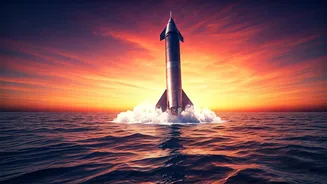
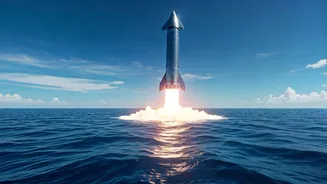
Upon re-entering Earth's atmosphere, Starship V3 gathered critical data regarding its heat shield's performance under extreme thermal stress. The spacecraft then executed maneuvers designed to rigorously test its rear flap control surfaces and to simulate the trajectory expected for future missions returning to their launch sites. Following a landing flip maneuver, the Ship initiated a landing burn using two of its Raptor engines. Ultimately, it splashed down and detonated in the Indian Ocean, concluding the test flight. This controlled descent and eventual destruction provided invaluable information on atmospheric re-entry dynamics and structural integrity.
Mission Success and Future Outlook
Despite the engine issues encountered during the flight, Elon Musk lauded the team's performance, calling it an 'epic first Starship V3 launch and landing' that 'scored a goal for humanity.' The test flight was deemed largely successful, providing SpaceX with a wealth of data essential for the development of Starship as a vehicle for lunar and Martian exploration. The successful execution of key maneuvers, even with engine failures, underscores the robustness of the Starship design and SpaceX's iterative development approach. This test comes at a pivotal time for SpaceX, as the company recently filed with the SEC for an IPO, with shares expected to begin trading on June 12.