





DeepSky's Ambitious Vision
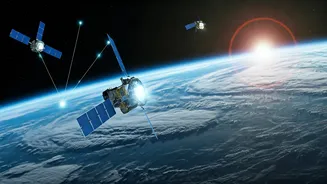
Tomorrow.io's DeepSky constellation represents a substantial advancement in the field of weather forecasting. Unlike the existing Gen1 constellation, DeepSky will
employ significantly larger satellites equipped with sophisticated instruments. These instruments will include advanced sensors, details of which are yet to be disclosed, but are intended to exceed the baseline requirements of major government and international entities. The goal is to provide the critical data needed to feed artificial intelligence models, thereby enhancing the precision and timeliness of weather forecasts. By complementing existing satellite systems, DeepSky seeks to improve the prediction of rapidly evolving and extreme weather events, signifying a major leap forward in weather intelligence.
Data-Driven Forecasting Era
The DeepSky initiative comes at a time when traditional weather models face limitations related to the availability of data. The evolution of weather modeling has been hindered by data bottlenecks and computational constraints. The advent of AI systems demands a massive influx of diverse, high-frequency observations, a requirement DeepSky is designed to fulfill. The focus is on providing the comprehensive data needed to support a new generation of sophisticated weather models, making the models more accurate. This marks a fundamental shift towards a data-driven approach to forecasting, enabling improvements in prediction capabilities.
Enhanced Operational Resilience
DeepSky aims to elevate operational resilience across various sectors. The project's strategy includes treating atmospheric data with the same rigor as critical infrastructure. As a result, AI-driven decision systems will be able to adapt and be localized with the use of better sensing and faster refresh rates enabled by the new technology. This advancement has the potential to transform numerous large-scale operations and supply chains. By incorporating continuous sensing and real-time intelligence, the initiative seeks to redefine how industries plan and react to atmospheric conditions. This change will affect railways, aviation, and disaster management.
DeepSky's Sensor Technology
DeepSky's satellites will be equipped with new sensor technologies, incorporating features that, previously, were restricted to specific scientific missions due to cost and data restrictions. The inclusion of these innovative sensors underlines the constellation's mission to collect thorough data for weather forecasting. Although specifics of the sensors are not public, it is known that the design will contain co-located sensors. These advanced capabilities are expected to support the gathering of data, leading to a significant increase in the quality of atmospheric data. The precise nature of these sensors highlights Tomorrow.io's commitment to pushing the boundaries of weather forecasting capabilities.
Complementing Existing Systems
DeepSky will complement present satellite systems, including the geostationary and low-Earth-orbit constellations, which provide data for public weather models. The new constellation is set to offer a more precise prediction of rapidly evolving and extreme weather occurrences. This collaborative approach enhances the current data infrastructure and improves the ability to predict and respond to dynamic atmospheric conditions. By working with current systems, DeepSky offers a more complete and dependable method for weather prediction, benefitting many sectors that rely on weather information, like agriculture and disaster management.
Customer and Partnership Impact
Tomorrow.io's Gen1 constellation has already attracted several customers, including the U.S. Air Force, and major enterprises like Ford, Uber, and BNSF Railway. The success of Gen1 sets the stage for DeepSky, with the new constellation intending to build on those foundations. This customer base highlights the increasing need for reliable weather data across varied sectors. The relationships between Tomorrow.io and its customers, who span a broad range of sectors, including supply chain management, demonstrate the broad relevance and impact of advanced weather forecasting.