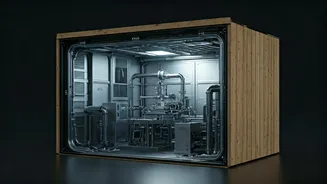








Shed to Semiconductor Space
The intricate world of semiconductor manufacturing, often associated with colossal, stadium-sized facilities, has been demystified by a remarkable backyard
project. This individual, operating under the moniker Dr.Semiconductor, has successfully constructed a cleanroom environment within a humble wooden shed, demonstrating that the core principles of contamination control are not exclusively confined to massive industrial complexes. The process utilized readily available construction materials, eschewing specialized, proprietary components for more accessible options. This includes standard insulation, framing to securely mount high-efficiency particulate air (HEPA) filters, and common heating and cooling systems. The interior walls of the shed were lined with drywall, or plasterboard as it's known elsewhere, and then coated with an epoxy finish. This creates a smooth, seamless surface crucial for preventing dust and particle accumulation. The design thoughtfully incorporates two distinct zones: an initial 'gowning' area where individuals prepare to enter the pristine environment, and the main cleanroom itself. This staged entry is fundamental to maintaining the ultra-clean conditions required for sensitive electronic component production, preventing the direct ingress of contaminants from the outside world.
The Air Pressure Advantage
The crucial element enabling this backyard cleanroom to achieve semiconductor-grade conditions is the clever implementation of positive air pressure. This principle ensures that the air pressure inside the cleanroom is maintained at a higher level than the surrounding external environment. Consequently, any air movement is directed outwards, effectively preventing the ingress of airborne contaminants. This is achieved through a sophisticated air filtration system. "Cleanroom grade" HEPA filters are employed to rigorously purify the air circulating within the cleanroom. Additionally, these filters also draw in a small amount of outside air, which is then scrubbed clean before being introduced into the system to help sustain the necessary positive pressure. The efficacy of this system is astounding; the air within the cleanroom is filtered hundreds of times every hour, drastically reducing the particle count. Using a particle detector, the creator measured approximately 40 particles per cubic foot, classifying the backyard 'lab' as Class 100. This classification is equivalent to that used by industry giants like TSMC, Intel, and Samsung, underscoring the impressive level of environmental control achieved in this unconventional setup.
Beyond the Cleanroom
While achieving a semiconductor-class cleanroom in a backyard shed is a monumental feat, it represents only the initial step in the complex journey of chip fabrication. The significant hurdles lie in acquiring and operating the specialized equipment necessary for actually manufacturing chips. For instance, the latest lithography machines, essential for etching intricate patterns onto silicon wafers, can cost hundreds of millions of dollars, as exemplified by machines from ASML. Beyond lithography, a multitude of other highly specialized and expensive tools are required. These include digital design software, electron-beam writers and plasma etchers for creating lithography masks, ion doping implanters for precisely introducing impurities into semiconductor materials, and atomic layer deposition tools for creating ultra-thin films. Furthermore, a miniature packaging plant would be needed to prepare the finished chips. Cumulatively, setting up a cutting-edge fabrication facility, or 'fab,' typically runs into tens of billions of dollars for high-volume production. While a DIY enthusiast might aim for a significantly lower, albeit still substantial, single-digit billion-dollar investment for hobbyist-level chip production, the cost remains prohibitively high for most individuals. This, coupled with the lack of readily available chip designs and the complexities of intellectual property rights, makes homebrew chip manufacturing an aspirational, rather than immediately practical, endeavor for the vast majority.