





Sketch to Simulation Speed
Traditionally, the journey from a car designer's initial sketch to a high-fidelity animation or simulation was a lengthy, multi-month endeavor involving
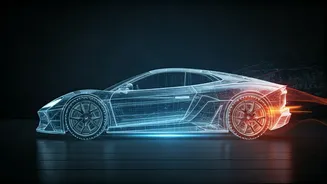
several specialized teams. However, General Motors is now employing generative AI tools, developed in partnership with an AI startup, to drastically compress this timeline. These sophisticated systems can take multiple hand-drawn sketches of a vehicle from various angles and rapidly construct a comprehensive 360-degree digital model. Beyond just static models, the AI can generate diverse visual interpretations of the design, simulate camera perspectives, and produce short video clips demonstrating the vehicle in motion. This capability allows concepts that once took months to visualize to be realized in under a single day, significantly expediting the early stages of vehicle development and allowing for much faster iteration on initial design concepts.
Virtual Aerodynamics Testing
A critical and time-consuming phase in vehicle development is aerodynamic testing, traditionally requiring complex computational fluid dynamics simulations that could take weeks to complete and involved extensive back-and-forth between design and engineering departments. GM has introduced an innovative AI-powered 'virtual wind tunnel' that can estimate aerodynamic drag in near real-time. This breakthrough technology allows an aerodynamicist and a creative designer to collaborate in front of a shared screen, making immediate design adjustments—such as altering a windshield angle—and receiving updated drag estimations in just over a minute. This near-instant feedback loop is revolutionary. Furthermore, AI has also influenced internal component design; one instance involved a machine-learning optimization tool proposing a novel structural reinforcement for the cabin, which bore a striking resemblance to a hip bone in its optimized form, effectively reducing cabin vibrations and showcasing the power of AI-driven optimization in vehicle engineering.
AI as Designer's Partner
Despite the increasing integration of AI into the design workflow, the company emphasizes that these technologies are intended to augment, not replace, human designers. The overarching philosophy is to create a unified, AI-enhanced workflow that streamlines the entire process from inception to completion. A primary benefit identified is the reduction of sequential handoffs between different stages and teams. This collaborative approach is empowering GM's designers to advance ideas from the conceptual phase towards production much more rapidly than before. While specific internal targets for reducing development timelines have not been disclosed, executives acknowledge the critical importance of adapting to the rapid advancements in AI. They view a proactive and unified strategy for leveraging AI as essential for staying competitive in an industry facing rapid change, suggesting that failure to embrace AI could lead to falling behind the accelerating pace of innovation.