







A Passion for Mangoes
In the heart of Malihabad, Uttar Pradesh, resides Kalimullah Khan, a man whose life revolves around the 'king of fruits.' Though he left formal education
after failing Class 7, Khan found his true calling and classroom within his family's mango orchard. Upon inheriting the land from his grandfather, he dedicated himself to the art of mango cultivation, transforming his passion into an unparalleled horticultural achievement. This dedication earned him the prestigious Padma Shri award in 2008 and a place in the Limca Book of Records, cementing his reputation as the 'Mango Man of India.' His sprawling 22-acre orchard is a testament to his lifelong commitment, with one particular 125-year-old tree standing as the crown jewel, a living exhibit of his genius.
The Grafting Mastermind
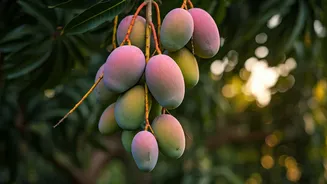
Khan's journey into innovative mango cultivation began in 1957 with a groundbreaking idea: to graft multiple mango varieties onto a single tree. This concept, initially involving seven types, evolved over decades into a breathtaking spectacle. By 1987, he accelerated his experiments on his grandfather's venerable tree, which has now stood for over a century. Through meticulous and relentless trials, this magnificent tree has transformed into a nine-meter giant, capable of producing an astonishing 300 to 350 distinct types of mangoes. The magic lies in precise grafting, the art of fusing healthy branches from diverse donor trees onto a strong rootstock, ensuring each variety retains its unique flavor, size, and color, a testament to Khan's profound understanding of horticultural science.
The Art of Grafting
The secret behind Khan's extraordinary achievement lies in the intricate art of grafting. This process, which he likens to solving a complex puzzle, involves carefully selecting compatible branches from various mango trees and skillfully joining them to a robust rootstock. This union requires patience and nurturing over several years before the fruits of his labor can be savored. Khan's son, Nazimullah, who joined his father's endeavor after leaving school, highlights the dedication involved, noting that hybrids like 'Dushehri Kalim,' a blend of Dushehri and Sinduri, took twelve long years to develop. They meticulously source seeds and branches from across India, ensuring genetic compatibility and ample space for each graft to thrive and mature into its unique form.
A Symphony of Flavors
Khan's celebrated tree is a veritable orchard of diversity, boasting an impressive array of mango varieties that cater to every palate. Among the well-known types are the velvety sweet Alphonso, the refreshingly tart green Langra, the fragrant and tangy Kesar, the juicy Dasheri, and the aromatic Chaunsa. But Khan's ingenuity extends further; he has also developed unique hybrids and named them after prominent figures who have inspired him. These include varieties such as 'Sachin Tendulkar,' 'Amitabh Bachchan,' 'Narendra Modi,' 'Anarkali,' and 'Aishwarya Rai.' This practice underscores his personal connection to his craft and his desire to honor individuals he deems significant, creating a living legacy that blends horticultural excellence with cultural homage.
Guardian of the Orchard
The daily care of this exceptional tree is a responsibility handled with utmost diligence by Nazimullah, Khan's son. His role involves constant monitoring of environmental factors, such as rainfall, which directly impacts the size and quality of the fruits. He manages potential challenges like waterlogged soil and diligently combats fungal infections and pests that could threaten the delicate ecosystem of the tree. As Nazimullah emphasizes, cultivating mangoes is not a swift undertaking; it demands extensive research, unwavering dedication, and considerable time. Kalimullah Khan, however, remains deeply passionate about his work, expressing a desire for others to witness his orchard and understand the distinct characteristics of each mango variety. His vision extends beyond his farm, with farmers from places like Dubai and Iran seeking to learn his innovative methods, inspired by his blend of traditional wisdom and modern horticultural techniques.