





Cosmic Computing Competition Heats Up
A significant race is underway to secure the necessary permissions for establishing data centers beyond Earth's atmosphere. A United States-based startup
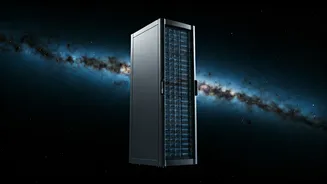
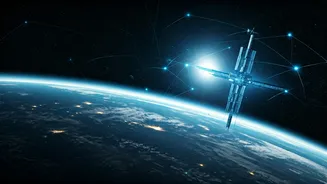
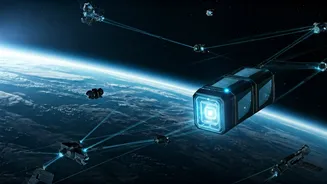
named Starcloud has put forth a proposal to the Federal Communications Commission (FCC) for a massive satellite network, potentially comprising up to 88,000 satellites. This development closely follows a similar filing by SpaceX, which intends to deploy as many as one million satellites. Starcloud has already conducted a pioneering test, launching a compact satellite equipped with a high-performance Nvidia H100 enterprise GPU. This mission successfully facilitated the training of a compact, open-source artificial intelligence model while in orbit, demonstrating the feasibility of space-based AI operations. While SpaceX has captured considerable public attention, Starcloud's initiative highlights a broader trend towards leveraging the unique attributes of space for advanced computing infrastructure. The vision is to harness the consistent solar power, efficient radiative cooling, and scalable power capabilities inherent in the space environment, offering a potential solution to the environmental concerns and grid strain associated with terrestrial data centers. This burgeoning competition suggests a potential surge in satellite application filings as other companies may be inspired to explore this frontier on a larger scale.
Celestial Advantages Explored
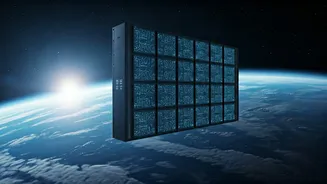
Companies championing the concept of space-based data centers are emphasizing the distinct benefits that an extraterrestrial location offers. These advantages include access to near-constant solar power, which can efficiently energize operations without interruption. Furthermore, the vacuum of space provides an ideal environment for radiative cooling, a far more effective method of heat dissipation than is typically achievable on Earth. This inherent cooling capability allows for the design of data centers with greater power densities and scalability, overcoming limitations imposed by terrestrial infrastructure. By moving computing operations off-planet, these ventures aim to alleviate the significant environmental impact and the strain on electrical grids that are increasingly becoming concerns with ground-based data centers. The potential for substantial gains in cost efficiency and operational performance is a primary driver behind this technological push. The ability to scale computing power and size without the physical constraints of Earth's surface presents a compelling argument for the development of orbital data processing hubs.
Giants and Skeptics Emerge
The discussion around space-based data centers is not limited to just a few players. Prominent figures like Jeff Bezos, the founder of Blue Origin, and Google have also publicly contemplated the concept. However, not everyone in the industry is convinced of its immediate feasibility. Matt Garman, the CEO of Amazon Web Services, recently expressed skepticism, pointing out the current limitations in launch capacity. He stated during the Cisco AI Summit that there aren't enough rockets available to launch the projected number of satellites, suggesting that a million-satellite constellation is still a distant prospect. Similarly, Sam Altman, the CEO of OpenAI, indicated at the TBPN show that he doesn't anticipate space data centers contributing a significant amount of computing power within the next five years. Industry analysts also raise questions about the practicality of these ambitious plans, citing numerous technical challenges and critical space safety concerns that need to be addressed before such large-scale deployments can be realized.
Regulatory Fast Track and Interdependencies
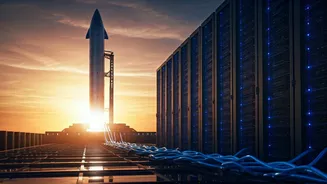
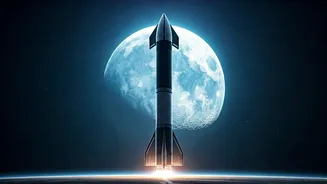
Despite some reservations, regulatory bodies appear to be fast-tracking key applications. The FCC, for instance, has accepted SpaceX's proposal for its million-satellite constellation, initiating a public comment period just days after its submission. Starcloud's own plans involve deploying satellites at altitudes between 600 km and 850 km in sun-synchronous orbits. However, the startup's ambitious vision appears to be heavily reliant on the infrastructure provided by larger entities like SpaceX. Starcloud's FCC application explicitly states its dependence on heavy-lift rockets, such as Starship, for the deployment of its extensive satellite network. Furthermore, the company envisions data transmission through laser links, connecting to third-party satellite constellations. These proposed interconnections include services like Starlink, Amazon's Project Kuiper, and Blue Origin's upcoming TeraWave network. The application details that these external networks will serve as the primary means for the Starcloud constellation to communicate with its users, underscoring a significant degree of interdependency in the burgeoning space data center ecosystem. Starcloud has already secured at least $21 million in funding to support its endeavors.