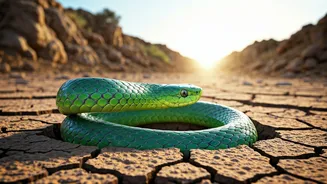

Early Hibernation Exit
Snakes, like many animals, enter a state of dormancy during the colder months, known as hibernation. This allows them to conserve energy and survive when
food is scarce. However, there have been increasing reports of snakes abandoning their hibernation spots earlier than usual. This is a noticeable deviation from their established behavioral patterns. Several factors can influence this, including changes in temperature or availability of food. The most intriguing possibility is that snakes are responding to some environmental cue. One of the prime suspects is seismic activity. The prospect that snakes might possess a natural ability to predict earthquakes is a captivating and thought-provoking idea that demands further examination.
Seismic Sensitivity in Snakes
The theory that snakes could anticipate earthquakes rests on their potential sensitivity to changes in the Earth's environment. Snakes possess a unique sensory system that could be more attuned to subtle environmental shifts than humans are. They may detect changes in the electromagnetic field, ground vibrations, or even the release of gases that precede an earthquake. The ability of snakes to sense ground vibrations is particularly relevant. Before an earthquake, there is often a buildup of stress in the Earth's crust, which can produce subtle vibrations. Snakes, living close to the ground, might be able to sense these vibrations, prompting them to leave their burrows for safety. While definitive scientific evidence is still emerging, the idea that snakes could be earthquake predictors has garnered attention.
Research and Observation
To understand the link between snakes and potential earthquake prediction, scientists are conducting research through observation and analysis. The core method is to monitor snake behavior, especially their hibernation patterns, and correlate them with seismic activity. Researchers often track snakes in areas known to be seismically active, using technology like radio transmitters to monitor their movements. Simultaneously, they collect data on earthquakes in the region, including the timing, magnitude, and location of these events. By comparing the snake's activity with seismic records, scientists seek to identify patterns. If there is a noticeable spike in snakes leaving hibernation before earthquakes, it could strengthen the hypothesis. However, the complexity of this research lies in distinguishing between the earthquake-related and other environmental triggers.
Challenges in Prediction
The process of predicting earthquakes is incredibly complex, regardless of whether animals are involved. Earthquakes occur due to the release of stress within the Earth's crust, which can happen at any time. Several factors must be considered to forecast the events. These include fault lines, geological structures, and historical seismic activity. Moreover, the environment also presents challenges. Fluctuations in weather, temperature, and food availability can cause fluctuations in animal behaviors. Distinguishing between earthquake-related behavior and the impacts of these environmental factors is crucial. Additionally, even if snakes do exhibit a response to earthquakes, it does not guarantee precise predictions. The challenge is to recognize the true signals among the noise.
The Future of Research
Even if snakes provide some insight into forecasting earthquakes, the ultimate goal of research is to save lives. Future research might involve developing advanced monitoring systems that combine data from various sources. This could include animal behavior, seismic sensors, and other environmental indicators. These tools can improve the chances of more accurate and timely warnings. The involvement of snakes or other animals is only one piece of the puzzle. Collaboration between biologists, geologists, and other scientists will be essential. Ultimately, the more we learn about the complexities of our planet, the better equipped we will be to protect our people from the destructive forces of nature. The early exit of snakes from hibernation is a fascinating topic with implications that extend far beyond the animal kingdom.