




A Glimpse Into The Past
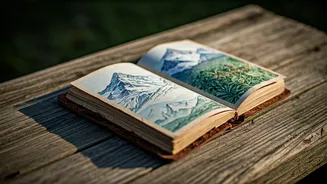
Delve into a remarkable exhibition in Delhi that brings to light 77 historical images, comprising both paintings and early photographs, meticulously created
by the German explorer siblings, the Schlagintweit brothers, approximately 170 years ago. These rare artifacts offer an unparalleled glimpse into the colonial-era explorations of what they termed 'high Asia.' For many in India, these visuals represent the very first public viewing of remote terrains, ancient temples, and dramatic landscapes as they existed nearly two centuries ago, providing a poignant contrast to the present day and satisfying a deep human curiosity about the evolution of our world. These visual records serve as invaluable historical documents, preserving moments in time that have since been profoundly altered by natural changes and human development.
The Schlagintweit Expedition's Genesis
The journey of the Schlagintweit brothers into the heart of the Himalayas began with a commission from the East India Company in 1854. Tasked with extending the magnetic survey of the Indian subcontinent, Adolph, Hermann, and Robert were pioneering figures, employing early photographic techniques in their extensive surveys. While the Great Trigonometrical Survey of India had already charted significant portions of the region, the northern Himalayan territories remained largely uncharted. Navigating a complex geopolitical landscape, with varying degrees of cooperation from regions like Kashmir and outright refusal from Nepal and Sikkim, the brothers charted a course through British-controlled areas and independent Himalayan states. Their work was groundbreaking, and they were among the first Europeans to utilize photography in their scientific expeditions in India, supplementing their photographic prints with meticulously crafted paintings, a testament to their dedication to documenting the region comprehensively.
A Treasure Trove Revealed
The current exhibition proudly displays 77 images, a selection from the Schlagintweits' extensive archive, with at least five pieces being unveiled to the public for the very first time. Among these novel reveals is a breathtaking panoramic depiction of Srinagar's Dal Lake, elegantly framed by majestic snow-capped peaks. Another newly displayed work captures the Bogapani Bridge, an impressive structure supported by sturdy wooden stilts, spanning a dramatic hillside in what is now Meghalaya. The broader collection features evocative scenes of the region's rivers, sacred temples, intimate village clusters, and rugged, high-altitude terrain from an era when the overarching ambition of colonial endeavors included a comprehensive mapping of the entire planet, reaching even the most inaccessible Himalayan frontiers. These high-quality reproductions are drawn from an impressive collection of approximately 700 original sketches, paintings, and early photographs of India and 'high Asia.'
Bringing History Back Home
The inspiring concept of repatriating these historical images to India originated in 2015. Co-curator Hermann Kreutzmann, upon visiting an exhibition at the Alpines Museum in Munich, was captivated by paintings depicting iconic locations like Nainital, Badrinath, Kedarnath, Kanchenjunga, Ladakh, and various Tibetan monasteries. This profound encounter sparked a desire to share this 'khazana' – a treasure trove – of visual heritage with the Indian public. The Schlagintweits' meticulous surveys and resultant maps laid crucial groundwork for subsequent meteorological and geological investigations in the Himalayas. Their scientific legacy extends beyond visuals; their extensive collections of rocks, minerals, plants, and ethnographic artifacts are now housed in museums across Germany, England, and even Pakistan, each piece a testament to their far-reaching impact.
Exhibition Tour Details
This significant exhibition is embarking on a journey, allowing diverse audiences across India to connect with their historical landscape. Following its debut in Delhi, the collection will travel to Dehradun, where it will be hosted at the Doon Library and Research Centre from May 1st to May 9th. Subsequently, the exhibition will make its way to Nainital, gracing the CRST Inter College with its presence from May 12th to May 18th. This carefully curated tour aims to provide audiences in the Himalayan region with an intimate and personal encounter with their own past. By exhibiting these poignant visual records, the event not only revives the compelling narrative of the Schlagintweit brothers' adventurous spirit but also serves as a profound reminder that the Himalayas are a dynamic, living landscape, as well as a vital, enduring archive of history.