



An Unexpected Hitch
Even the most advanced scientific missions can face unforeseen complications, and NASA's venerable Curiosity rover on Mars was no exception. During a seemingly
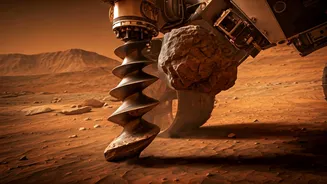
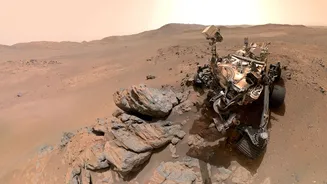
standard rock sampling operation, an unusual situation arose that baffled mission controllers. The rover's primary tool for geological investigation, its drill, designed to pulverize Martian rocks into fine dust for analysis, encountered a rock fragment that refused to cooperate. Instead of disintegrating as expected, a piece of the targeted rock adhered itself to the drill sleeve, a component not intended to carry such material. This peculiar attachment immediately flagged the situation as an anomaly, presenting a small yet significant engineering hurdle for the team back on Earth.
The 'Atacama' Encounter
The peculiar incident unfolded while Curiosity was engaged with a rock formation designated 'Atacama.' The rover meticulously executed its drilling sequence, a process refined over years of Martian exploration. This routine involved the robotic arm deploying its drill onto the rock's surface. However, on this occasion, a segment of the rock exhibited unexpected tenacity. Rather than breaking down into the expected powder, a larger piece lodged itself firmly onto the stationary drill sleeve that encircles the spinning drill bit. This was a departure from normal operations, as the sleeve's function is purely protective, not for material transport. Subsequent imagery captured by the rover's cameras confirmed the rock's persistent presence, even after the drilling cycle concluded, hinting at a developing challenge.
Earthbound Problem-Solving
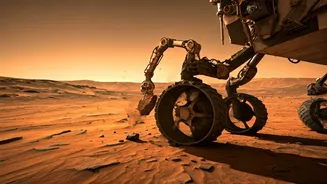
With the rock firmly in place, NASA's dedicated engineers on Earth swung into action. The process of controlling Curiosity involves meticulously planning and transmitting commands across vast interplanetary distances. Their initial approach was one of caution, employing gentle maneuvers such as slight arm movements and subtle vibrations, hoping to dislodge the errant fragment. Slow rotations of the drill were also attempted, with the hope that gravity would do its work. However, these initial efforts proved ineffective; the rock remained steadfastly attached. Over the subsequent days, the team escalated their attempts, experimenting with different arm angles, more pronounced vibrations, and controlled spinning of the drill mechanism. Despite these persistent adjustments, the rock showed no signs of budging, solidifying the challenge.
The Decisive Maneuver
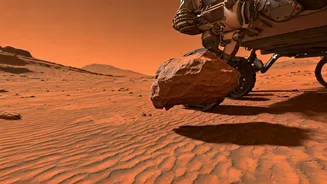
After a series of unsuccessful attempts, the engineering team devised a more robust strategy. On May 1st, Curiosity executed a carefully choreographed sequence involving a more forceful combination of tilting, rotation, and vibration applied to both the robotic arm and the drill system. This calculated exertion finally proved successful. The stubborn rock fragment detached from the drill sleeve and plummeted back to the Martian surface. Mission updates later indicated that the rock suffered minor fracturing upon its impact. This resolution marked the end of an unusual, albeit minor, engineering quandary and confirmed the rover's encounter with the first known instance of an entire rock becoming lodged in its drill sleeve during its extensive mission.
Geology's Quirky Nature
Curiosity's core mission involves collecting powdered samples from Martian rocks for analysis within its onboard laboratories. These analyses are crucial for deciphering Mars's geological history and assessing its past habitability. However, the Martian surface is not homogenous; rock compositions vary significantly. Some rocks are characterized by soft, layered structures, while others are notably brittle or possess unusual densities. Experts posit that these intrinsic variations in rock properties can occasionally lead to such unexpected outcomes during the drilling process, highlighting the dynamic and sometimes unpredictable nature of planetary exploration.