





Mythical Inspiration
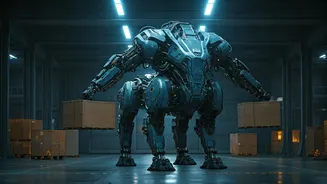
Drawing inspiration from legendary creatures of Greek mythology, a team of engineers in Shenzhen, China, has developed a novel robotic system. This unique
appendage, shaped like a centaur with a horse-like lower body and a human-like torso, offers a distinctive approach to reducing the physical burden of carrying substantial weight. Unlike conventional solutions that might employ wheels or other mechanical aids, this robot directly collaborates with its human operator, striding alongside them. Initial observations show the robot's two legs working in tandem with the wearer, a configuration that becomes particularly advantageous when encountering obstacles like staircases, where wheels often falter. This innovative design aims to redefine assisted locomotion and load management in a way that feels almost fantastical.
Enhanced Load Management
The primary advantage of this centaur-inspired robotic system lies in its remarkable ability to reduce the 'metabolic cost' for the wearer, essentially making heavy loads feel significantly lighter. Researchers found that when a person carried a weight equivalent to a 44-pound backpack, their energy expenditure was substantially lower when assisted by the Centaur robot. This collaborative approach allows the robot to optimize the distribution of weight, thereby lessening the pressure on the human's body. Moreover, the system is designed for interaction, capable of generating a forward assistive force at the human-robot interface, giving the wearer a gentle push to aid their forward movement. This dynamic assistance is crucial for maintaining efficiency and comfort during prolonged carrying tasks across various environments.
Addressing Robotic Limitations
While autonomous robots like robotic dogs are being developed for load-carrying, they face inherent limitations. These include challenges in reliably navigating complex and unmapped environments, restrictions on payload capacity, and significant battery drain that limits endurance. The researchers highlight that despite advancements in autonomous navigation and power management, these robots still struggle to fully execute load-carriage tasks independently. The centaur approach offers a compelling alternative by leveraging human navigation capabilities. By working in conjunction with a human operator, the Centaur robot bypasses many of the navigation and payload constraints that plague fully autonomous systems, making it a more practical solution for real-world applications where adaptability and capacity are paramount.
Versatile Terrain Adaptation
The Centaur robot demonstrates an impressive capacity to adapt to diverse human walking patterns and speeds, seamlessly integrating with the user's movements. Its design allows it to effectively navigate varied terrains, including uneven ground and inclines, areas where wheeled robots would struggle. The experimental evaluations have confirmed its proficiency in adapting to different human gaits and directions of travel, ensuring a smooth and collaborative experience. This adaptability is a key differentiator, making the robot suitable for a wide range of applications, from industrial settings to personal assistance. Its ability to handle changes in direction and speed effortlessly ensures that the wearer can move with confidence and reduced effort, regardless of the surrounding environment.