






Atmospheric Analysis
One of the most significant advancements in exoplanet research during 2025 involved detailed atmospheric analysis. Scientists employed advanced telescopes
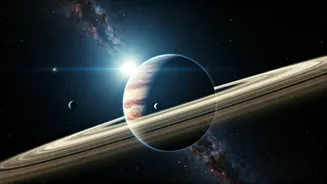
and spectroscopic techniques to study the atmospheres of various exoplanets. They looked for the presence of key molecules, such as water, methane, and oxygen, which could indicate the potential for habitability. One remarkable study focused on a super-Earth exoplanet, revealing the presence of complex organic molecules in its atmosphere. This discovery suggested the possibility of prebiotic chemistry occurring on the planet, hinting at the potential for life's building blocks to exist. Another noteworthy achievement involved the detection of cloud formations and weather patterns on a gas giant exoplanet, similar to those seen on Jupiter. These observations offered valuable insights into the dynamics and climate of exoplanets.
Habitable Zone Finds
The discovery of exoplanets residing within their stars' habitable zones marked another significant highlight of 2025. The habitable zone is the region around a star where conditions are suitable for liquid water to exist on a planet's surface, a crucial ingredient for life. Several exoplanets were found within the habitable zones of their respective stars. One of the most promising candidates, a planet orbiting a red dwarf star, displayed characteristics similar to Earth, including a rocky composition and potential for liquid water. This discovery sparked considerable excitement among the scientific community, as red dwarf stars are relatively common in our galaxy, increasing the likelihood of finding habitable planets. Another notable finding involved an exoplanet orbiting a sun-like star, where scientists confirmed the presence of a substantial atmosphere. This finding further boosted the prospects of habitability, as the atmosphere could potentially shield the planet from harmful radiation.
Planetary Formation Insights
In 2025, exoplanet discoveries also contributed significantly to understanding planetary formation. Scientists studied the composition and structure of exoplanets to gather insights into the processes that led to their creation. One study focused on a young exoplanet system, revealing the presence of a protoplanetary disk, a swirling cloud of gas and dust from which planets form. By analyzing the composition of the disk, scientists gained insights into the raw materials that go into planet formation. Another significant finding was the detection of a 'hot Jupiter,' a gas giant exoplanet orbiting very close to its star. This discovery helped scientists understand the migration patterns of planets within their systems, as hot Jupiters were believed to have formed farther away and then migrated inwards. Furthermore, researchers used advanced computer simulations to model planetary formation, providing a more detailed understanding of the dynamic processes involved in creating diverse planetary systems. These insights enhanced our understanding of the factors that influence planetary characteristics and the potential for habitability.
Technological Advancements
Technological advancements also played a crucial role in exoplanet discoveries in 2025. New telescopes and sophisticated instruments provided scientists with improved capabilities for observing and analyzing exoplanets. The launch of advanced space telescopes with larger mirrors and enhanced sensitivity allowed astronomers to capture detailed images of exoplanets and study their atmospheres with unprecedented accuracy. Furthermore, advanced data analysis techniques, including artificial intelligence and machine learning, were applied to process large datasets and identify subtle patterns in exoplanet observations. The development of advanced spectroscopic instruments allowed for more precise measurements of the light passing through exoplanet atmospheres, revealing the presence of specific molecules. These advancements significantly improved the precision and scope of exoplanet research, opening new avenues for discoveries and the exploration of distant worlds.
Future Prospects
The year 2025 was a significant period in exoplanet research, and the findings have fueled anticipation for future discoveries. Scientists are planning upcoming missions and advancements to build upon the successes of 2025. The James Webb Space Telescope, a powerful successor to the Hubble Space Telescope, is expected to continue its exploration of exoplanet atmospheres, providing even more detailed information about their composition and potential for habitability. New space missions are in development, specifically designed to search for and characterize exoplanets. The development of even more powerful telescopes, both on the ground and in space, will further enhance our ability to discover and study exoplanets, potentially revealing new information about their composition, atmospheres, and the possibility of life beyond Earth. Continued advances in technology, data analysis techniques, and international collaboration will pave the way for exciting discoveries and revolutionize our understanding of exoplanets in the years to come.