






A New Era of Stealth
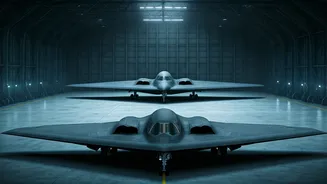
The United States Air Force is on the cusp of welcoming a new era of aerial dominance with the introduction of the Northrop Grumman B-21 Raider. This cutting-edge
bomber shares its foundational flying wing design, a characteristic devoid of vertical stabilizers, with its renowned predecessor, the B-2 Spirit. Visually, the B-21 evokes an almost otherworldly aesthetic, a testament to its advanced aerodynamic principles. Development for this marvel began in 2015, laying the groundwork for what promises to be a significant leap in strategic aviation capabilities. While a superficial glance might suggest the B-2 and B-21 are of comparable stature, the Raider is, in fact, considerably more compact. Although precise dimensions remain classified, it's estimated the Raider boasts a wingspan of approximately 140 feet and a length around 55 feet. This contrasts sharply with the B-2 Spirit, which features a more expansive 172-foot wingspan and a length of 69 feet.
Size Matters: Stealth and Savings
The question naturally arises: given that the B-2 Spirit first took to the skies in the 1980s, why is the newer B-21 Raider designed to be smaller? The answer is multifaceted, revolving around the principle that in the realm of multi-million, and often multi-billion dollar, sophisticated machinery, sheer size does not always equate to superior performance. A primary driver for this reduction in scale is cost-efficiency; utilizing fewer materials in the construction of a smaller aircraft directly translates to reduced manufacturing expenses. Beyond financial prudence, the B-21's diminished dimensions unlock enhanced stealth capabilities. This smaller profile allows for greater operational flexibility, enabling the aircraft to undertake a wider array of future missions with increased effectiveness. The strategic advantage is clear: a smaller radar cross-section, the measure of how detectable an object is by radar, makes the Raider significantly harder for enemy detection systems to identify, especially with its radar inlets integrated deeper into the fuselage for an even more streamlined and compact form factor.
Technological Evolution and Cost
The advancements born from two decades of technological evolution and the integration of 21st-century innovations have significantly contributed to the B-21 Raider's more compact and upgradable design compared to older aircraft like the B-2 Spirit. This generational leap in engineering allows for greater efficiency and reduced complexity. Production costs are another critical factor influencing the size and design of modern military hardware. Each B-21 Raider is projected to cost approximately $692 million to produce, a substantial investment, especially when contrasted with aircraft that might cost around $317 million each. However, these figures are dwarfed when compared to other advanced aerial platforms. The operational fleet of B-2 Spirits is currently limited to just 20 aircraft, whereas the United States Air Force has ambitious plans to acquire at least 100 B-21 Raiders to bolster its strategic capabilities. The Raider is intended to eventually supersede the B-2 fleet and supplement existing fleets. Fundamentally, the reduced dimensions of the B-21 enable Northrop Grumman to potentially manufacture more Raiders at a lower per-unit cost than its predecessor, making cost a significant and practical consideration in the aircraft's development and deployment strategy.