




Lunar Science Payload Integration
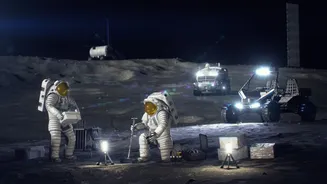
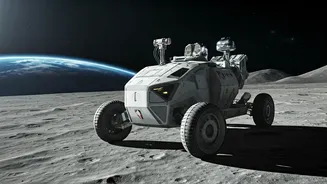
Astrolab's forthcoming lunar rover, known as the FLEX Lunar Innovation Platform (FLIP), is poised to embark on its maiden voyage by carrying four distinct
scientific instruments developed by NASA. These payloads have been secured through agreements with various NASA research centers, aiming to leverage FLIP's mission for valuable lunar surface data collection. The rover is slated for a late-year launch aboard Astrobotic's Griffin-1 lander, marking a significant step in commercial lunar exploration. Astrolab proactively approached NASA centers to identify instruments that were development-ready and aligned with the scientific objectives deemed beneficial for future lunar endeavors. These collaborations are structured under nonreimbursable Space Act Agreements, facilitating swift negotiations and ensuring the payloads fit within the mission timeline, thereby enabling the rover to be ready for its scheduled launch.
Investigating Lunar Resources
One of the key payloads aboard the FLIP rover originates from NASA's Ames Research Center, named the Moon Exploration for Titanium with Active Lighting (METAL). This sophisticated instrument comprises a camera and radiometer specifically engineered to detect and map concentrations of helium-3 within the lunar regolith. Notably, this initiative is a collaborative effort with Interlune, a company that had previously announced its own plans to deploy a helium-3 prospecting instrument on the FLIP rover. The inclusion of METAL underscores the mission's potential to contribute valuable insights into resources that could be vital for future lunar bases and energy production, directly addressing NASA's interest in lunar resource utilization.
Studying Lunar Environment
Complementing the resource exploration payload are three other significant scientific contributions from different NASA centers. Goddard Space Flight Center is providing a lunar retroreflector array, a fundamental tool for precise distance measurements between the Earth and the Moon. Meanwhile, Johnson Space Center is contributing the Lunar Dust level sensor and Effects on Surfaces (LDES) payload. LDES is designed to investigate the detrimental impact of lunar dust on critical spacecraft systems, a pervasive challenge in sustained lunar operations. Lastly, Marshall Space Flight Center is sending a lidar demonstration payload, aimed at showcasing advanced remote sensing capabilities for lunar terrain mapping and characterization, further enhancing our understanding of the lunar environment.
Rover Readiness and Future Prospects
Astrolab has confirmed that the FLIP rover is now largely complete and is set to undergo rigorous environmental testing, including assessments for shock, vibration, and thermal vacuum conditions. Having previously tested individual rover components, the company expresses confidence in the upcoming comprehensive evaluations. The plan is to finalize these tests and have FLIP ready for deployment to the launch site by the end of summer, where it will be integrated with the Griffin-1 lander for its late-year liftoff on a Falcon Heavy rocket. Concurrently, Astrolab is actively engaged in refining a more advanced rover concept for NASA's Artemis lunar exploration program, demonstrating their commitment to long-term lunar surface mobility solutions.