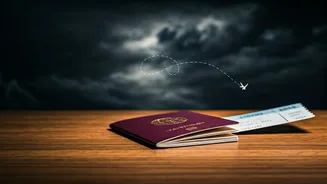







Airline's Role First
When flights face unexpected cancellations or delays due to geopolitical tensions, the airline is your primary contact for resolution. Carriers will typically
offer refunds, future travel credits, or rebooking options based on their specific policies. Travel insurance usually functions as a secondary safety net, potentially covering additional expenses incurred from these disruptions, such as missed onward connections. However, it's vital to recognize that insurance coverage often has limitations when cancellations stem directly from issues like airspace closures or conflict-related safety concerns. In many such scenarios, your recourse for compensation will primarily depend on the airline's provisions rather than your insurance claim.
Stranded Expenses Explained
Being unexpectedly stranded due to widespread flight disruptions can lead to a cascade of unforeseen costs, including accommodation, meals, and local transportation. Certain travel insurance plans may offer reimbursement for these expenses, but typically only after a predefined waiting period and up to a specified financial cap. Significant disruptions, like prolonged airspace shutdowns resulting from international incidents, often fall outside the scope of standard insurance coverage. Consequently, if you find yourself stranded for an extended period due to conflict-driven travel restrictions, you might be responsible for a portion of the resulting financial burden.
Advisories Impact Claims
Official government travel advisories significantly influence the eligibility of your insurance claims. If you embark on a trip after a formal warning has been issued, particularly one advising against non-essential travel to a region, your insurance coverage for issues related to that specific situation may be substantially reduced or entirely invalidated. However, if an advisory is published after your journey has commenced, some insurance policies may still honour related claims. The specifics of this clause vary widely between providers, making it one of the most critical aspects to scrutinize in your policy documentation before purchasing.
War & Conflict Fine Print
It is common for most travel insurance policies to contain explicit clauses that exclude coverage for events related to war, armed conflict, and significant political unrest. Consequently, any claims that are directly or indirectly linked to such occurrences are frequently denied. While emergency medical situations, such as requiring hospitalization or medical evacuation due to injuries sustained, generally remain covered, non-medical evacuations prompted by unsafe environmental conditions are far less certain. In these critical situations, individuals might need to rely on evacuation efforts coordinated by their respective governments.
Pre-Purchase Checks
The true value of a travel insurance policy is revealed in its detailed terms. Before committing to a purchase, meticulously review the exclusions related to conflict, the precise definitions of 'delay' and 'cancellation,' and the extent to which expenses incurred while stranded are covered. It is also essential to understand how travel advisories affect claim validity, whether non-medical evacuations are included within the policy's scope, and if 24/7 emergency assistance is provided during major disruptions. In today's volatile travel landscape, having absolute clarity on these points serves as your most robust form of protection.