





The Flexible Black Sea Bass
Along the Atlantic coast, the Black Sea Bass demonstrates a fascinating growth-dependent gender transition. Most of these fish begin their lives in a specific
biological phase. Once they reach a certain maturity, typically between three to five years of age, a notable portion of the population undergoes a physical change. Researchers suggest this transformation is influenced by environmental cues and population dynamics. If the balance of males and females becomes skewed, the largest and most robust individuals will shift their sex to compensate, ensuring the species has ample breeding opportunities and thus guaranteeing its continuity.
Bidirectional Hawkfish
The Hawkfish stands out as an exceptional example of a 'bidirectional' gender switcher, meaning it can shift its biological status in either direction depending on the prevailing social circumstances. This adaptability is crucial for maintaining equilibrium within their communities. If a group becomes overpopulated with dominant individuals, a member can revert to a prior biological state. Conversely, if the group requires a leader, an individual can transition to fill that role. This inherent flexibility makes the Hawkfish a remarkably resilient inhabitant of the reef ecosystem, capable of adjusting to changing social structures.
Transforming Bluehead Wrasse
In the vibrant tropical coral reefs, the Bluehead Wrasse is renowned for its swift and dramatic transformations. These fish typically start their lives as small, yellow-hued individuals within a larger school. However, should the dominant, brightly colored leader of the group be removed, a crucial vacancy arises that requires immediate filling. The largest fish present in the school then assumes this leadership role. This transition is accompanied by astonishing physical changes; within mere days, the fish's coloration shifts to striking blue and green hues, and its internal reproductive biology completely reconfigures to take on the responsibilities of a new protector and breeder for the community.
Clownfish Colony Dynamics
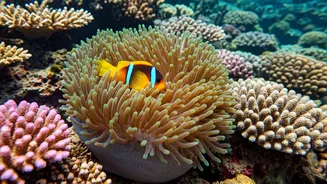
The social organization within a clownfish colony is characterized by a strict hierarchy, yet it's underpinned by a remarkable biological fluidity. Each colony is typically comprised of a dominant breeding pair and several non-breeding subordinate members. In the event that the primary breeding individual disappears or falls prey to a predator, the largest remaining subordinate doesn't merely step into the leadership void; it undergoes a complete physiological metamorphosis. Over a relatively short period, its digestive and reproductive organs reorganize, enabling the fish to seamlessly transition into a breeding capacity, thereby preserving the colony's reproductive cycle and preventing its collapse.
Slipper Snail Stacks
Slipper snails present a unique case of biological adaptation, growing in dense, stacked formations. Their position within these vertical arrangements dictates their biological role. Generally, the larger, more mature snails at the base of the stack function as breeders. Younger snails, joining the stack at the top, begin life in a different reproductive state. As the colony evolves and older members at the bottom are lost, individuals situated in the middle of the stack gradually shift their biology to maintain the essential balance of breeding and non-breeding individuals. This creates a fascinating biological 'ladder' where an individual's physical and reproductive identity is directly determined by its placement within the stack.