




Decoding Aurora Dynamics
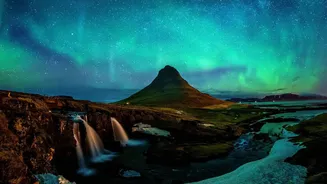
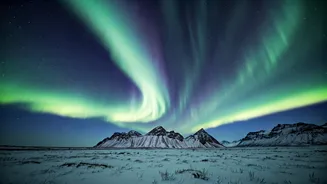
The mesmerizing spectacle of the aurora borealis, often called the northern lights, is a direct result of dynamic interactions between the Earth's magnetic
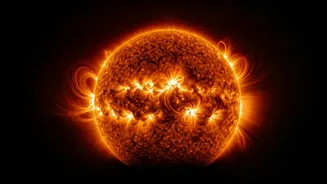
field and charged particles originating from the Sun. These particles, primarily electrons and protons, are ejected from the Sun in the form of solar wind. When this solar wind, especially when enhanced by Coronal Mass Ejections (CMEs) or streams from coronal holes, encounters our planet, it gets channeled along the magnetic field lines towards the polar regions. As these energetic particles collide with atoms and molecules in Earth's upper atmosphere, such as oxygen and nitrogen, they excite them, causing them to emit light. The color of the aurora depends on the type of gas molecule and the altitude at which the collision occurs; oxygen typically produces green and red hues, while nitrogen contributes blues and purples. The intensity and visibility of auroras are directly correlated with the strength of geomagnetic activity, often measured by the Kp-index. Higher Kp-index values indicate more significant geomagnetic disturbances, leading to auroras visible at lower latitudes. Recent forecasts have highlighted periods of heightened solar activity, including incoming CMEs and fast solar wind streams from coronal holes, suggesting favorable conditions for aurora viewing. Conversely, periods of quiet solar activity result in the auroras being confined to higher, polar latitudes.
Timing Your Aurora Hunt
Successfully witnessing the aurora borealis requires a keen understanding of timing and optimal conditions. While auroras can occur at any time of year, the longer, darker nights of autumn and winter in high-latitude regions offer the best viewing opportunities. Factors such as clear skies, away from city light pollution, are paramount. Geomagnetic storms, often triggered by Earth-facing coronal mass ejections (CMEs) or high-speed solar wind streams from coronal holes, are key drivers of visible auroras. Forecasters closely monitor these solar events. For instance, reports frequently mention incoming CMEs that could spark geomagnetic storms, increasing the likelihood of auroras visible even at mid-latitudes, such as Illinois or Oregon. Conversely, when geomagnetic activity wanes, the auroral oval contracts, confining the lights to the polar regions. Aurora forecasts often predict 'quiet' nights or periods where activity is expected to 'ease' or 'subside,' indicating lower chances for widespread visibility. However, these forecasts also frequently point to potential 'upticks' in activity, often linked to the arrival of specific solar phenomena like fast solar winds or CME impacts, which can significantly boost aurora potential. Observing these patterns allows aurora enthusiasts to plan their viewing excursions effectively, maximizing their chances of experiencing this natural wonder.
Factors Influencing Visibility
The captivating dance of the northern lights is influenced by a confluence of space weather phenomena, making precise forecasting a complex but rewarding endeavor for aurora chasers. The primary drivers are solar events like coronal mass ejections (CMEs) and high-speed solar wind streams emanating from coronal holes. When these energetic particles from the Sun are directed towards Earth, they interact with our planet's magnetosphere, a process that can lead to geomagnetic storms. These storms, often categorized by their intensity (e.g., G1 for minor, G4 for severe), are crucial for extending aurora visibility beyond the usual high-latitude regions. Reports detail instances where strong geomagnetic storms have allowed auroras to be seen as far south as Illinois and Oregon, or even Italy. Conversely, periods of 'quiet geomagnetic activity' or 'waning solar winds' mean the auroras are typically confined to the polar regions, making them harder to spot for observers at lower latitudes. Even subtle changes in solar wind speed and density, or the arrival timing of CMEs, can significantly impact the visual display. Space weather forecasts often highlight these factors, predicting 'elevated conditions,' 'minor storming,' or 'fading activity,' to guide enthusiasts on when and where to look up for the best celestial show.