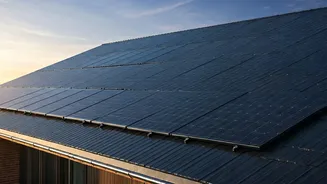








Seamless Solar Integration
The visual integration of solar energy components into the built environment has taken a significant leap forward thanks to pioneering work by the Fraunhofer
Institute. Researchers have developed a novel method to apply a special film to photovoltaic modules, which can then be intricately etched using laser technology. This process creates microscopic surface structures that manipulate light reflection, allowing the solar panels to convincingly replicate the appearance of common building materials such as roof tiles or masonry. The effectiveness of this approach is akin to the structural coloration seen in nature, such as the iridescent wings of Morpho butterflies, where color is generated by the physical arrangement of microscopic textures rather than traditional pigments. This capability offers architects and building owners unprecedented flexibility in incorporating solar power without compromising the architectural integrity or aesthetic appeal of their properties, particularly on historically sensitive structures.
Aesthetic Versatility & Performance
This innovative film technology provides remarkable aesthetic versatility, allowing solar modules to match the color and texture of existing building materials, from the rustic look of roof tiles to the classic appearance of masonry. Martin Heinrich from the Fraunhofer Institute for Solar Energy Systems highlights its particular advantage for applications like facade-integrated photovoltaics, roof-integrated systems, and even railings, especially on historical buildings where visual harmony is paramount. While this technological advancement does introduce a slight reduction in efficiency, typically by a few percentage points, the resulting modules still operate at approximately 95% efficiency. In many instances, this performance is comparable to or even surpasses that of conventional solar modules. The institute emphasizes that this approach is superior to other visually integrated solutions currently available on the market, ensuring that aesthetics do not necessitate a significant compromise in energy generation capabilities. Moreover, the film can be applied to both standard photovoltaic and solar thermal modules, making it adaptable for retrofitting existing structures.
Future Commercialization Prospects
The commercialization of this aesthetically focused solar module technology is anticipated to be swift. While currently not yet available on the market, the Fraunhofer Institute is actively working on translating its research into tangible products. Michael Scholles, a corporate business development manager at the institute, stressed that bridging the gap between scientific discovery and industrial application is a core part of their mission. This technology builds upon previous innovations from Fraunhofer ISE, such as a new type of solar cell that achieves lower conversion costs. Sven Kluska, a group leader for electrochemical processes at the institute, projects that this electroplating technique could become well-established in the photovoltaic sector within the next two to three years, despite the initial investment required for manufacturers to integrate electroplating equipment. The institute views this as a crucial step in making solar energy adoption more accessible and appealing to a wider range of architectural contexts, especially where visual considerations have historically limited the implementation of solar panels.