






What is Quantum Memory?
Quantum memory represents a sophisticated technological advancement designed to preserve the delicate quantum state of particles, such as photons or elementary
particles. The primary function of a quantum memory is to capture and hold this quantum information, making it accessible for later retrieval without any degradation. This capability is crucial because quantum states are inherently fragile and tend to be lost or altered once they are measured or interact with their environment. Therefore, quantum memories are inherently prone to volatility, much like traditional volatile memory in computers, but on a fundamentally different and more sensitive scale. The challenge lies in maintaining the integrity of these quantum states over time, which is a key focus of research and development in this field. The ability to store and recall quantum information accurately is a cornerstone for many future quantum technologies, including computing and advanced sensing applications.
Telescopes and Resolution
The ability of a telescope to capture detailed images is directly tied to the amount of starlight it can gather; more light collected translates to higher image resolution. While building physically larger telescopes offers a straightforward path to better images, there are significant engineering and cost limitations that constrain their ultimate size. Astronomers employ an ingenious technique known as interferometry to circumvent these physical size restrictions. This method involves combining the light captured by multiple, spatially separated telescopes. By precisely merging these light signals, an interference pattern is created, which can then be analyzed to reconstruct a single, significantly higher-resolution image. In essence, this array of telescopes effectively mimics a much larger single telescope, capable of collecting more faint starlight and revealing finer details in celestial objects. This principle was famously demonstrated by the Event Horizon Telescope (EHT) collaboration, which used a network of radio telescopes spread across the globe to achieve an effective diameter equivalent to the Earth itself, enabling the first image of a black hole.
Optical Interferometry Challenges
Applying the principles of interferometry to shorter wavelengths of light, such as visible light, presents considerably greater technical hurdles compared to radio astronomy. The primary difficulty arises from the loss of photons as light travels from individual telescopes to a central combining point. For instance, the most extensive optical interferometer currently in operation, the CHARA array, comprises six telescopes situated at the Mount Wilson Observatory in California. These telescopes work together to achieve an effective combined diameter of 330 meters. Despite this impressive scale, the method of spatially combining the light beams can lead to significant signal degradation, limiting the overall effectiveness and the maximum achievable baseline (the distance between the furthest telescopes) for such optical interferometers. Overcoming this photon loss is a critical challenge for achieving higher resolution in optical astronomy using interferometric techniques.
Quantum Memory's Novel Approach
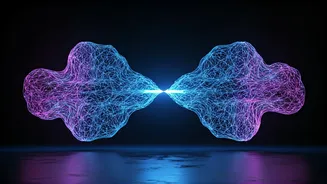
A recent breakthrough presented at the Global Physics Summit in Denver introduces a revolutionary method for optical interferometry that leverages quantum memory. Instead of physically combining light beams, researchers are now recording the quantum information of each detected photon into a quantum memory. This quantum state is then entangled with the quantum state stored in another quantum memory associated with a photon from a different telescope. This entanglement allows for the creation of an interference pattern without the need to physically transmit and combine the light signals, thereby circumventing the photon loss inherent in conventional methods. This innovative approach promises to significantly enhance the effective diameter of telescope arrays and improve the signal-to-noise ratio, opening up new possibilities for astronomical observation.
The Diamond Quantum Memory
The experimental setup employs two telescopes located within the same building, separated by 6 meters, but connected by a 1.5-kilometer spool of optical fiber. Each telescope is equipped with a quantum memory, ingeniously fabricated as a nanoscale cavity within a diamond chip. These specialized diamonds feature a 'silicon vacancy' defect, where a silicon atom and a vacant spot replace two carbon atoms in the crystal lattice. Within this defect, an electron spin and a nuclear spin act as qubits, serving as the fundamental units for storing and manipulating quantum information. Before each observation, the nuclear spins of the two diamond chips are entangled using precisely timed light signals. This entanglement creates a strong quantum link between the two memories, essential for the subsequent quantum teleportation of photon states.
Quantum Teleportation in Action
To simulate incoming starlight, a weak laser beam is directed at the two telescopes. When a photon interacts with an electron within the quantum memory at the first telescope, its quantum information is transferred to the electron spin. This electron spin then influences the silicon's nuclear spin, effectively imprinting the photon's quantum state onto the nuclear spin qubit. Due to the pre-established entanglement between the nuclear spins of the two quantum memories, the quantum state of the original photon is reproduced at the second memory. This is achieved by performing specific measurements on the electron and nuclear spins at the first telescope, which, via entanglement, dictates the state at the second. This process, akin to quantum teleportation, allows for the combined processing of photon signals from both telescopes.
Achieving Higher Resolution
This quantum teleportation-driven method enables the fusion of photon signals from the two telescopes, facilitating the creation of an interference pattern. Crucially, this is accomplished even though the telescopes are effectively separated by 1.5 kilometers – a distance more than four times greater than the baseline of the CHARA array. The significant advantage of this quantum approach lies in its ability to avoid the substantial photon loss typically encountered when conventional interferometers transmit light signals over long distances to a central processing unit. This circumvention of photon loss directly addresses the primary limitation of traditional interferometry, which restricts the maximum achievable baseline and thus the ultimate resolution of the combined telescope system. By minimizing signal degradation, this quantum memory technique dramatically enhances the effective diameter of the telescope array.
The Future of Cosmic Views
Quantum memories hold immense promise for revolutionizing optical astronomy. By enabling the construction of low-loss, high-effective diameter arrays of optical telescopes, this technology can significantly boost the resolution of our observational instruments. This enhanced resolution will allow astronomers to peer deeper into the universe than ever before, potentially revealing intricate details of distant galaxies, exoplanets, and other celestial phenomena. The ability to combine light signals with minimal loss opens up new avenues for studying the most enigmatic cosmic objects and processes, pushing the frontiers of our understanding of the universe and potentially uncovering mysteries that have long remained hidden from view.