







The Satellite Lifespan Dilemma
Satellites in geostationary orbit (GEO), vital for communication and monitoring, often face premature retirement due to outdated technology or insufficient
fuel. These assets, costing hundreds of millions to launch, are typically designed with redundancy and extra fuel to maximize their 15-year lifespan, but once in orbit, they are beyond repair. This contrasts sharply with low Earth orbit (LEO) satellites, like those in SpaceX's Starlink constellation, which have shorter lifespans but are designed for frequent, low-cost replacement. The immense investment in GEO satellites makes their limited operational life a significant concern, leading to the development of solutions that can sustain their functionality and value in the harsh environment of space.
RSGS: A New Era of Space Servicing
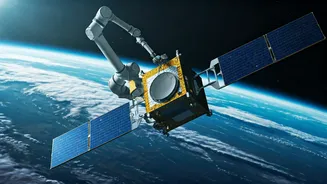
DARPA's Robotic Servicing of Geosynchronous Satellite (RSGS) program is set to redefine space operations by introducing a robotic servicer capable of performing essential maintenance on satellites in geosynchronous orbit, approximately 22,236 miles above Earth. The program aims to move away from the 'disposable' model of space assets towards a sustainable approach where satellites can be upgraded, repaired, and relocated. This initiative, slated for a 2026 launch, will feature a highly dexterous robotic system designed for critical tasks such as on-orbit upgrades, inspections, anomaly resolution, and satellite relocation. The ultimate goal is a versatile servicing spacecraft that can operate for years and assist numerous satellites, going beyond simple refueling to ensure prolonged mission success and reduce the growing problem of space debris.
Robotic Dexterity in Orbit
The core of the RSGS mission is its sophisticated robotic servicing suite, engineered for intricate tasks in the challenging environment of deep space. This advanced robotic system will be mounted on a spacecraft built by a subsidiary of Northrop Grumman, integrating DARPA's payload with their proven Mission Extension Vehicle. After its launch in 2026, the robotic servicer will embark on a 10-month journey to reach geosynchronous orbit. Once there, its primary function will be to address issues that currently lead to satellite deactivation, including performing upgrades to hardware, conducting detailed inspections for any signs of wear or damage, resolving unexpected operational anomalies, and even relocating satellites to different orbits. This level of robotic capability is unprecedented for assets operating at such extreme distances from Earth.
Overcoming Development Hurdles
The RSGS program has experienced significant delays since its initial announcement in 2017, encountering various setbacks that have pushed back its launch date. Early challenges included issues with the original contractor, then known as Maxar Technologies, followed by widespread supply chain disruptions caused by the global pandemic. More recently, the new prime contractor, SpaceLogistics, faced hurdles in integrating DARPA's specialized payload onto their spacecraft. Despite these obstacles, DARPA has confirmed that the RSGS demonstrator is now ready for its upcoming launch. The program is a collaborative effort involving NASA and the U.S. Naval Research Laboratory, all working to ensure the robotic servicer can adapt safely and efficiently to a wide range of on-orbit missions and environmental conditions.