






Orbital Data Centers
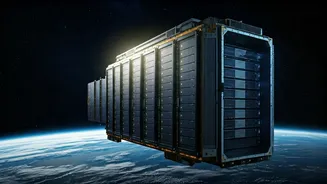
The future of space innovation hinges on powerful data centers operating directly in orbit, a domain where Nvidia is making significant strides. The company's
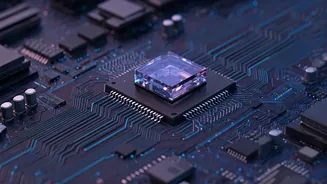
latest efforts focus on equipping these orbital data centers (ODCs) with advanced Artificial Intelligence capabilities, particularly Large Language Models (LLMs) and sophisticated foundation models. A key development is the Space-1 Vera Rubin Module, designed to serve as a high-performance computing hub in space. This module integrates a novel Rubin GPU, which offers a remarkable leap in AI computation, boasting up to 25 times more processing power than its predecessor, the H100. Coupled with a high-bandwidth interconnect system, it's engineered to handle and process the immense volumes of data streamed from space-based instruments in real time, enabling immediate analysis and decision-making while the data is still being collected.
On-Orbit Edge Computing
Nvidia's advancements extend to enabling true edge computing capabilities directly on orbit, meaning data can be processed and analyzed right where it's generated, without needing to transmit it back to Earth for initial analysis. Platforms like IGX Thor and Jetson Orin are central to this vision. These systems are designed for energy efficiency while delivering robust AI inference performance, advanced image sensing, and accelerated data processing. This capability is crucial for enabling autonomous operations, real-time situational awareness, and rapid responses in space. The seamless operation of AI applications, whether moving from ground to space, or between different points in space, is a core objective, supporting increasingly complex missions and paving the way for the widespread adoption of orbital data centers.
Ground-Based Geospatial Power
While the focus is on space-based computing, Nvidia's terrestrial data center platforms also play a vital role in supporting space innovation. On Earth, high-throughput processing is essential for managing and analyzing the vast amounts of geospatial data gathered from space. The RTX PRO 6000 Blackwell Server Edition GPU is an example of hardware designed for such tasks. It offers on-demand processing power that significantly accelerates the analysis of massive imagery archives, such as weather data. Compared to traditional CPU-based batch systems, these platforms can deliver up to 100 times faster performance, allowing for quicker insights and more efficient handling of complex geospatial intelligence. This synergy between ground and space capabilities ensures a comprehensive approach to leveraging data from beyond our atmosphere.
Unlocking New Discoveries
The integration of advanced AI and powerful computing in space is set to unlock a new era of scientific discovery and operational efficiency. On-orbit analytics, autonomous scientific exploration, and the rapid generation of actionable insights are among the key processes that will be transformed. These capabilities will push the boundaries of what is currently possible in space technology. Already, six commercial space companies have reportedly begun deploying the Space-1 Vera Rubin Module, indicating a strong industry adoption and validation of these advancements. This progress signifies a fundamental shift, where intelligence is no longer confined to Earth but resides wherever data is generated, enabling more sophisticated and self-sufficient space missions.