





Canine Social Acumen
Recent behavioural studies are shedding new light on our canine companions, suggesting they are far more sophisticated social judges than previously understood.
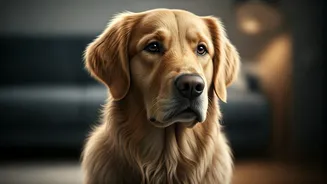
It turns out dogs are not merely responding to direct interactions but are actively evaluating the people around their owners. They possess an innate capacity to discern negative or uncooperative behaviour directed at their human, a phenomenon referred to as 'third-party affective evaluation.' This means your dog might be forming opinions about your friends based on how those friends behave towards you, even if you haven't noticed anything amiss. This ability goes beyond simple loyalty; it indicates a deep-seated observational skill that influences their willingness to engage with new people. The research highlights that dogs are actively processing social dynamics within their environment, making them silent, four-legged arbiters of human connection.
Reading Unspoken Cues
Unlike humans, who rely heavily on verbal communication, dogs interpret the world through a rich tapestry of non-verbal signals. They are exceptionally adept at picking up on tone of voice, subtle shifts in body language, and the overall emotional energy radiating from individuals. A dismissive glance, a sigh of impatience, or even a slight tension in your posture can be registered by your dog with remarkable accuracy. Veterinarians confirm that dogs are highly sensitive to these cues and can mirror the discomfort or unease they perceive in their owners. This keen sensitivity explains why a dog might shy away from someone who, on the surface, seems perfectly friendly. They are not just reacting to an immediate situation but to a complex interplay of social signals that humans might easily overlook or rationalize away. This allows them to form judgments independently of spoken words.
Domestication's Edge
The advanced social perceptive abilities observed in dogs are thought to be a direct result of thousands of years of cohabitation and domestication alongside humans. This long-standing partnership has likely honed their capacity to interpret not only commands but also the emotional nuances and relational dynamics of human society. Living in close proximity has made them hyper-attuned to their owners' states of being and the interactions they experience. Experts suggest this evolutionary advantage allows them to be more effective companions, able to anticipate needs and provide comfort. When your dog hesitates or shows apprehension towards a particular individual, it might be an instinctive, yet informed, response to subtle cues that you yourself might not have consciously registered. This deep connection makes them incredibly sensitive to the social environment they share with their human families.
A Mirror to Society
In essence, dogs can serve as an unbiased social mirror, reflecting the true nature of interactions that might otherwise go unnoticed or unacknowledged. While human social graces often involve politeness and the masking of true feelings, dogs respond directly to perceived authenticity and behaviour. If your dog appears hesitant or aloof with someone, it might be their way of signaling that something about that person's behaviour feels off, even if it’s not overtly hostile. This instinctual response can be a valuable, albeit silent, form of feedback. Researchers are still exploring the full extent of this canine social intelligence, but the evidence points towards dogs being far more perceptive observers of human behaviour than we often give them credit for. Their reactions can offer an unfiltered perspective on the people we invite into our lives, prompting us to pay closer attention to what our pets are trying to tell us.