






Ancient Origins & Function
The dupatta boasts an ancestry stretching back over three millennia, with early evidence found in the Indus Valley Civilization. A well-known sculpture,
the "Priest-King," depicts a cloth draped over the shoulder, hinting at its ancient presence. The name itself, derived from Sanskrit, signifies "two strips of cloth." During the Vedic period, it was known as an uttariya and served as a practical, unstitched cloak worn by both men and women. Its primary purposes were protection from the elements and maintaining a sense of modesty. In these early times, the focus was less on the material composition and more on the skill and style with which the fabric was draped, underscoring its functional and aesthetic importance even then. This early iteration laid the groundwork for the garment's enduring significance.
Mughal Elegance & Luxury
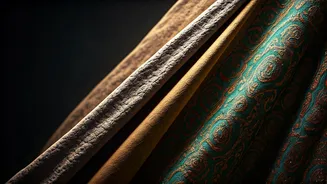
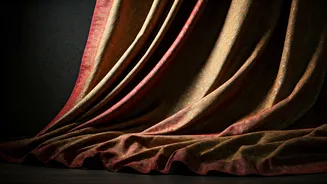
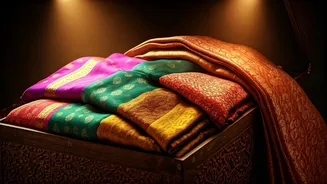
The arrival of the Mughals marked a pivotal transformation for the dupatta, elevating it from a simple utilitarian item to a luxurious statement piece. Influenced by Persian aesthetics, the royal courts began incorporating opulent fabrics such as rich silks, plush velvets, and intricate brocades into dupatta designs. For noblewomen of both Hindu and Muslim faiths, the dupatta became an integral part of the purdah system, a tradition emphasizing modesty. However, rather than receding into the background, these women transformed the dupatta into a focal point of their attire. They adorned it with elaborate embellishments, including pearls, precious gemstones, heavy embroidery, and fine zari (gold and silver thread) work, turning it from a mere covering into a canvas of wearable art and a clear expression of status and taste.
Gender Norms & Honor
The dupatta's narrative is deeply intertwined with complex gender norms and societal expectations. For generations, it became a symbol closely associated with a family's 'izzat,' or honor, serving as a marker of female virtue. The act of covering one's head or chest with the dupatta was not merely a fashion choice but a prescribed demonstration of a woman's purity, dignity, and respect for social traditions and elders. While these patriarchal underpinnings have historically been significant, contemporary urban fashion has introduced a new perspective. Although the practice of draping the dupatta over the head continues to be a gesture of respect in religious settings like temples, mosques, and gurdwaras, its role has evolved considerably outside these sacred spaces. It is now largely perceived as an optional element for personal style expression rather than a mandatory requirement for modesty.
Regional Artistry & Craftsmanship
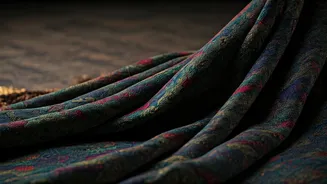
As the dupatta traversed the Indian subcontinent, it was adopted and reinterpreted by local artisans, each imbuing it with distinct regional characteristics and craftsmanship. Examining the diverse dupatta styles offers a geographical tour of India's rich textile heritage. Punjab is renowned for its vibrant Phulkari, characterized by bold, geometric floral embroidery. Varanasi contributes the exquisite Banarasi weave, featuring intricate gold and silver zari work for unparalleled luxury. Gujarat and Rajasthan are celebrated for Bandhani, a sophisticated tie-dye technique creating precise dotted patterns. Lucknow showcases the delicate elegance of Chikankari, with its intricate white-on-white embroidery, while Andhra Pradesh presents Kalamkari, featuring hand-painted or block-printed cottons adorned with detailed mythological narratives. These varied styles highlight the dupatta's role as a canvas for diverse artisanal traditions.
Bollywood's Glamour Revolution
By the latter half of the 20th century, Bollywood played a significant role in redefining the dupatta's cultural image and appeal. For those who grew up in the 1990s, the iconic scenes of actresses dramatically swirling sheer chiffon dupattas, often enhanced by wind machines, are unforgettable. This cinematic portrayal cemented the dupatta as a powerful symbol of romantic idealism and an essential element of on-screen glamour. This resurgence in popularity and visibility ultimately brings us back to contemporary discussions, such as the recent 'Scandinavian Scarf' trend. While the appropriation of such a deeply rooted cultural garment by global fashion without acknowledging its origins can be frustrating, it also serves as a powerful reminder of the dupatta's enduring legacy and its status as a 3,000-year-old survivor that continues to be a cherished part of our wardrobes.