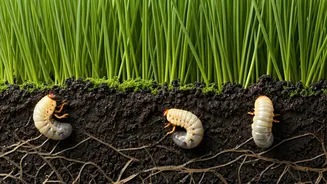








Understanding Lawn Grubs
Lawn grubs are essentially the larval stage of scarab beetles, posing a significant threat to the health of your grass by feasting on its root system and
stems. While adult beetles may cause damage to ornamental plants and crops, it's the subterranean larvae that wreak havoc on turf. Different species, such as Japanese and June beetle grubs, are commonly found across the United States, thriving particularly well in regions with ample rainfall and moist soil conditions. Recognizing the presence of these pests is the first crucial step in maintaining a lush and healthy lawn, as their activity can quickly escalate into a widespread infestation.
Spotting Grub Infestations
Identifying a grub problem often involves noticing several distinct visual cues in your lawn. One of the most prevalent signs is the appearance of irregular patches of grass that are dying or completely dead, which tend to expand over time. These affected areas will look dry, thin, and wilted, even when the rest of the lawn appears healthy. You might also notice that the turf feels unusually spongy underfoot, a characteristic of weakened roots. Another key indicator is that sections of the sod can be easily peeled back or lifted, as the grubs have compromised the root structure. Beyond visual changes, the presence of numerous small holes from digging animals like skunks, raccoons, opossums, squirrels, or foxes, searching for grubs as a food source, is a strong indicator. Mole activity, characterized by tunneling and mounding, can also be linked to grub presence. Furthermore, an unusual abundance of birds such as crows, grackles, and starlings congregating on your lawn, or visible swarms of beetles near ground level, can signal an underlying grub issue.
Checking For Grubs
A prime time to inspect your lawn for grubs is during the early autumn months, when they are typically more active and closer to the surface. To conduct a thorough check, select a few different areas of your lawn where you suspect an infestation might be occurring. Using a spade or trowel, carefully dig up several square-foot sections of turf, going down about two to four inches deep. Once you've lifted a section of sod, meticulously count the number of grubs present. If you find more than five Japanese or June beetle grubs within any single square-foot sample, it strongly indicates that you have a problem requiring attention and treatment.
Preventive Grub Control
Implementing a preventive strategy is key to averting a serious grub problem. This approach involves applying specific insecticides early in the summer, typically between early to mid-summer. Chemicals like imidacloprid, thiamethoxam, or clothianidin are effective at targeting and eliminating newly laid grub eggs. While these treatments won't affect adult grubs already present, they significantly reduce grub populations for the following spring. An alternative, chlorantraniliprole, can be applied slightly earlier, in late spring, and has the advantage of not harming bees. Before applying any preventive treatment, it's advisable to mow your lawn to remove any flowering weeds that might attract pollinators. Also, be mindful to prevent drift onto flowerbeds and ornamental plants. For granular products, a fertilizer spreader ensures even distribution, while liquid formulations can be mixed with water and sprayed. Regardless of the product type, always water it into the soil to a depth of about half an inch to ensure it reaches the grub-feeding zone.
Curative Grub Treatments
When grubs are already actively feeding, curative insecticides become necessary to reduce the current season's population. Carbaryl and Trichlorfon are among the few insecticides that can effectively tackle existing grub issues. However, their success hinges on proper timing; lawns must be treated before the grubs cease feeding and enter their pupal stage, which usually occurs in late spring. These treatments are generally short-acting, meaning they are less persistent than preventive options, but they can be applied from early autumn right through to late spring when grubs are most voracious. It's important to note that it might take several weeks to observe the full impact of these treatments. As with preventive applications, it's recommended to mow your lawn beforehand to protect foraging pollinators. Distribute granular products evenly with a fertilizer spreader and water them in thoroughly to a depth of half an inch. Following up with adequate watering and fertilization can help the lawn recover. For long-term control, consider a preventive application the following summer.
Natural Grub Solutions
For those seeking environmentally friendlier approaches, several natural methods can help manage grub populations. Milky spore is a bacterial disease that offers long-term control specifically for Japanese beetle grubs. It's most effective when there are at least ten grubs per square foot, and it can take two to four years to achieve complete eradication across an infected lawn. The bacteria remain dormant until ingested by warm larvae, at which point they activate and spread. To apply, distribute the milky spore powder in a grid pattern, about a teaspoon every four feet, with rows four feet apart. It can be applied at any time, but works best when larvae are young. Milky spore is harmless to other insects and can persist in the soil for up to fifteen years. Beneficial nematodes are microscopic worms that actively hunt and parasitize grubs. They enter the grubs through their body openings, multiply rapidly, and kill them. Nematodes can be tricky to use, as they are susceptible to direct sunlight and can become sterile. They come in various forms like sponges, gels, or granules and are best applied to moist soil in the early morning, late evening, or on overcast days. Store them in the refrigerator for up to three weeks. If the soil is dry, water it to a depth of half an inch before application. Results are typically seen within three to four weeks, though extended dry spells might necessitate a second application. Neem oil, a botanical pesticide, disrupts the feeding, growth, and egg-laying cycles of grubs and is most effective when applied from late summer into early autumn. Follow product instructions for mixing and application. Diatomaceous earth, a natural powder made of silica, works by dehydrating and killing soft-bodied insects, including grubs, by cutting into their exoskeletons. While effective, it also affects beneficial insects, so it's best used for spot treatments according to label directions.
When to Seek Professional Help
In certain situations, it may be more practical and effective to enlist the services of a professional lawn care specialist. Some state and municipal regulations mandate a license for the application of specific insecticides, which homeowners may not possess. If your lawn exhibits a significant number of grubs per square foot, or if you observe large swarms of adult beetles, multiple treatment applications might be necessary to bring the population under control. In these instances, hiring a professional can be more efficient and cost-effective than attempting to manage the problem independently. They have the expertise, proper equipment, and access to regulated products to address severe infestations effectively.