




Bread of the Dead
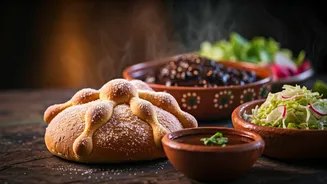
Pan de Muerto, a sweet, fragrant bread baked in late October, is intrinsically linked to Día de los Muertos. This specially prepared bread is placed on
family altars, alongside symbolic offerings like candles and marigolds, with the express purpose of nourishing the spirits of deceased loved ones who are believed to return for visits on November 1 and 2. Unlike many dishes whose original meanings have faded, Pan de Muerto continues to fulfill its foundational role as a direct physical offering to the afterlife. Its distinctive shape carries deep symbolism: the small orb atop represents the skull, the dough strips radiating downwards signify the bones of the departed, and they also point to the four cardinal directions, a nod to ancient Aztec deities. The overall roundness of the loaf further reinforces the concept of the eternal cycle of life and death. Interestingly, this sacred bread is not solely for the deceased; it is traditionally shared by the living at the gravesites of their departed family members and can be enjoyed for weeks leading up to the holiday in some regions. The act of preparing Pan de Muerto itself is a crucial part of the ritual, blurring the lines between the living and the dead and preserving a vibrant cultural practice.
Puebla's Rich Sauce
Mole Poblano, a deeply flavorful, reddish-brown sauce, is often mistakenly associated with Cinco de Mayo due to its regional ties to Puebla. However, its true importance transcends this military commemoration, though it remains a cherished dish served traditionally with turkey or chicken during its festivities. The preparation of mole is renowned for its immense complexity, involving a vast array of ingredients – including various chiles, seeds, nuts, spices, and Mexican chocolate – which are individually toasted, ground, and then simmered to create its characteristic velvety texture. While its precise origin is a blend of historical accounts and folklore, with one popular legend attributing its creation to a convent in Puebla striving to impress a visiting archbishop, its profound ritualistic value lies in its intricate creation process. In indigenous Mesoamerican cultures, similar complex sauces, known as 'molli,' were meticulously ground on stone metates as offerings to deities. Following the Spanish conquest, this sacred grinding tradition merged with European ingredients, culminating in the ultimate celebratory sauce. The ritualistic aspect extends beyond mere symbolism or its role in bridging culinary traditions; the extensive time, often days, required for its authentic preparation makes mole-making a communal undertaking, a 'labor of love.' This process necessitates collaboration and meticulous attention from multiple generations in the kitchen, transforming cooking into a shared cultural ceremony that marks significant life events such as weddings, baptisms, and patron saint festivals.
Hominy Stew's Roots
What we recognize today as a hearty and comforting hominy corn stew, Pozole Rojo, actually traces its origins back to a time when its consumption carried life-or-death ritualistic weight, long before it became a common meal. Whether enjoyed in Mexico or across the American Southwest, a large pot of steaming Pozole Rojo is a quintessential symbol of celebration and togetherness. It's a dish deeply ingrained in traditions for New Year's Eve, Christmas Eve, and Mexican Independence Day. However, in pre-Hispanic Mesoamerica, the act of eating this particular soup held a literal significance tied to survival. The Aztecs revered maize as a divine gift, a sacred substance. To honor Xipe Totec, their god of agriculture, fertility, and renewal, priests would prepare a ceremonial version of the stew known as 'tlacatlaolli.' The crucial ingredients, apart from the revered corn, included the flesh of defeated enemy warriors. By consuming this stew, the Aztec elite believed they could absorb the essence and strength of the sacrificed individuals, symbolically ensuring the land's continued fertility for another growing season. Post-Spanish conquest, the Catholic Church's prohibition of cannibalism led to the substitution of human flesh with pork, a meat that conquistadors noted bore a striking resemblance in taste. Even in contemporary times, as this nourishing stew is served to crowds from Albuquerque to Mexico City, the fundamental spirit of Pozole endures: it is a dish designed to invigorate gatherings while honoring an ancient, enduring tradition.