



Cosmic Blasts Unveiled
Recent observations have unveiled mysterious bright blue cosmic blasts that originate from supermassive black holes. These events are not caused by exploding
stars, but by the gravitational forces of black holes tearing stars apart. The material is flung out at incredible speeds, reaching up to 134 million mph. The energy released from such an event is almost beyond comprehension. This discovery suggests a previously unknown mechanism by which black holes can influence their surroundings. Scientists are exploring how these occurrences shape galactic evolution and how often they occur throughout the cosmos. Further research aims to understand the composition and origin of the ejected material, offering more clues about the black hole's environment.
Violent Star Destruction
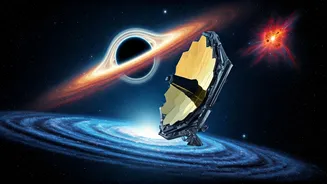
Black holes have been observed destroying stars in a process that releases immense amounts of energy. A notable example involved a 'super star' being shredded, releasing energy equivalent to 400 billion suns. The process involves the black hole's powerful gravity pulling the star apart. This phenomenon emits a brilliant flare, with the power of 10 trillion suns, often visible across vast cosmic distances. This kind of event offers scientists a chance to study the black hole's immediate environment and the material it is consuming. Scientists are also watching how the black hole impacts the structure and content of its host galaxy. Such studies assist in understanding the evolution of galaxies over cosmic timescales.
Spacetime Distortions Observed
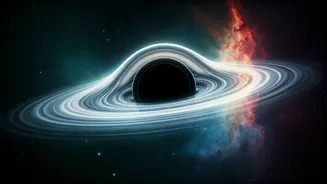
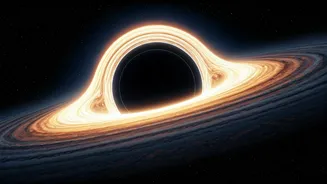
Scientists have observed a black hole dragging the fabric of spacetime, a phenomenon predicted by Einstein's theory of general relativity. The gravitational pull of the black hole is so intense that it distorts spacetime. This distortion can be observed when a black hole is feasting on material, creating measurable effects on light and other signals passing by. This observation validates Einstein's predictions and confirms our understanding of the extreme nature of black holes. Observing the warping of spacetime provides crucial insights into how black holes influence the universe's structure at the largest scales and allows scientists to understand the forces at play in their extreme environments. This provides confirmation of theoretical models.
Galactic Flares Detected
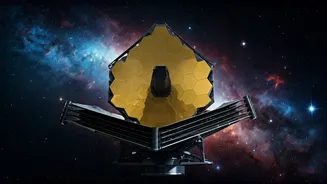
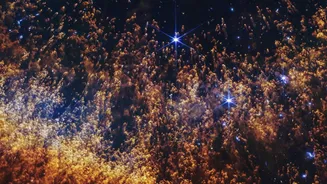
The James Webb Space Telescope and other instruments have detected massive flares emitted by black holes at the center of galaxies, including our Milky Way. These flares represent bursts of energy released by the black hole, offering clues about the matter it's consuming. These flares can be seen across vast distances, providing information on the black hole's activity and the environment. Scientists can study these flares to understand the physics of black hole accretion and the interaction between black holes and their host galaxies. Monitoring these flares provides insight into the history of black holes and the evolution of the galaxies they inhabit, giving scientists new perspectives on the structure of galaxies.
Runaway Black Holes Found
Scientists have identified a 'runaway' supermassive black hole. It is rocketing through its home galaxy at speeds up to 2.2 million mph. This is an extraordinary finding, as black holes are not typically observed moving at such speeds. The cause of such high speed is not yet fully understood. This discovery offers new perspectives on how black holes interact with their environments and how they can be displaced from their galactic centers. Scientists are trying to figure out the processes that can propel black holes to such speeds, while potentially shedding light on galactic dynamics and galaxy mergers, which are essential for cosmic evolution. This research continues to surprise.