




Orbital Robot Debut
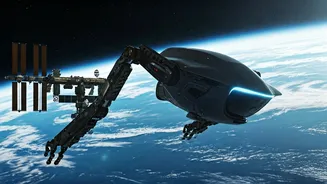
A significant development in space robotics is on the horizon, with plans announced for a novel free-flying platform, named Joyride, to undergo testing
on the International Space Station (ISS). This initiative is a collaborative effort between Voyager Technologies and Icarus Robotics. Voyager will be instrumental in managing the integration of the payload, ensuring safety certifications are met, coordinating the projected 2027 launch, and overseeing all aspects of on-orbit operations for Joyride-1. This technology demonstration represents a major step towards validating advanced robotic capabilities in the challenging environment of space. The collaboration underscores a shared vision for enhancing the utility and safety of robotic systems operating beyond Earth's atmosphere, aiming to bring more autonomy and efficiency to space missions.
Icarus Robotics Mission
Icarus Robotics, a company established in Brooklyn, New York, in 2024, is dedicated to creating sophisticated mobile robots capable of performing routine, laborious, and potentially dangerous duties in orbit. The upcoming Joyride-1 mission is crucial for their objective. Ethan Barajas, co-founder and CEO of Icarus Robotics, emphasized that this flight will serve as a critical validation point. It will demonstrate the robot's ability to safely navigate and execute tasks in proximity to human astronauts, moving beyond simulations and brief parabolic flights. The mission's high-level goals include verifying the platform's design for manipulation tasks on various interfaces and test articles, managing cargo logistics efficiently, and proving its competence in safe free-flight navigation. These capabilities are vital for Icarus Robotics' future endeavors in space operations.
Safety and Certification
Beyond functional validation, the Joyride-1 mission carries significant weight in its adherence to NASA and the Center for the Advancement of Science in Space (CASIS) safety and flight certification protocols. Barajas highlighted the critical importance of this process, especially for an autonomous free-flyer operating within a crewed station. Successfully navigating this rigorous certification pathway is essential for establishing an operational precedent for this new category of robotic systems. Achieving this flight heritage and certification is what will position Icarus Robotics as a credible and reliable operational platform, ready to contribute to the growing demand for on-orbit labor in the future. This methodical approach ensures that new technologies are integrated safely and effectively into existing space infrastructure.
Voyager's Expertise
Voyager has a proven track record in mission management, having successfully overseen more than 1,400 missions for a diverse range of government and commercial clients. These missions have focused on conducting microgravity research and validating new technologies. Matt Magaña, president of Voyager Space, Defense & National Security, expressed that their mission management as a service is specifically designed to support companies, whether established or innovative startups, in transforming their concepts into flight-proven realities. He sees Icarus Robotics as a prime example of the next generation of space innovators. Voyager's commitment is to provide a comprehensive, turnkey solution for those seeking dependable access to space, backed by extensive experience and a robust operational framework. This partnership leverages Voyager's extensive experience to accelerate the development and deployment of cutting-edge space technologies.
Inspiring Future Missions
The genesis of Icarus Robotics is rooted in influential experiences, with co-founder Ethan Barajas drawing inspiration partly from his involvement in NASA's High Schools United with NASA to Create Hardware (HUNCH) program. Barajas credits this program with providing his initial, tangible exposure to spaceflight. Through the Joyride-1 mission, Icarus Robotics aims to reciprocate this foundational support by delivering a robotic platform designed to enhance the functionality of the ISS and future commercial space stations, such as Starlab. This initiative represents a full circle, where early inspiration leads to the development of technologies that will contribute to the ongoing advancement and operational efficiency of space exploration and commercialization efforts, solidifying the impact of early STEM engagement.