





Exotic Watermelon Varieties
Ram Pratap Sharma, a 63-year-old farmer from Siwah village in Panipat, Haryana, has become renowned for cultivating an astonishing array of watermelon
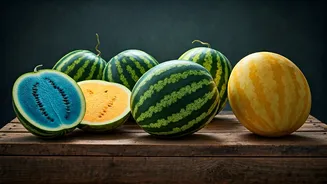
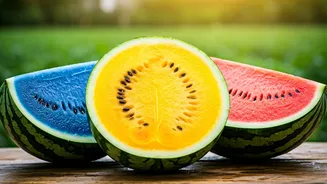
colors, diverging from the traditional green rind and red flesh. His farm now proudly showcases varieties with flesh in shades of red, orange, yellow, and remarkably, even blue. These are not just visually striking but also represent a significant innovation in fruit cultivation. Sharma's dedication has earned him prestigious accolades, including the Krishi Rattan Award in 2019, highlighting his pioneering efforts. He transitioned to full-time fruit and vegetable farming in 2011, adopting modern agricultural practices like polyhouses, net coverings, and drip irrigation systems, which have proven highly effective in enhancing crop quality and yield. His farm's strategic location near National Highway-44 allows for swift delivery of produce to markets in Panipat, Delhi, Gurgaon, Chandigarh, and Ludhiana, catering to a diverse clientele including industrialists and online businesses. Sharma's operational scale is substantial; he employs seven laborers and cultivates over 20 different vegetables each season, often employing intercropping techniques, alongside fruits like guava and dragon fruit. This year, he allocated 1.5 acres specifically to his unique watermelon varieties, with the remaining land dedicated to crops such as spinach, fenugreek, guava, peach, and pomegranate, demonstrating a diversified agricultural approach.
The 'Rainbow' Phenomenon
The term 'rainbow watermelons' aptly describes the sensational produce cultivated by Ram Pratap Sharma, who has successfully introduced five distinct and visually stunning watermelon varieties. Unlike the typical watermelon, his special cultivations boast flesh colors that range from the familiar red to vibrant orange, deep yellow, light yellow, and an unexpected, captivating blue. These unique colors are achieved through the meticulous sourcing of premium watermelon seeds from Thailand and Taiwan. Sharma invests approximately ₹1 lakh for just 1 kilogram of these specialized seeds, a significant expense considering that only about 300 grams are required to cultivate an entire acre, supporting around 6,000 plants. This investment underscores the high value and exotic nature of his produce. The market reception for these distinctive watermelons has been overwhelmingly positive, with Sharma selling them at a competitive price of ₹50 per kilogram. He has also developed and introduced three novel varieties named 'Low Munch,' 'Orange Munch,' and '24 Carat Gold.' The 'Orange Munch' variety features a standard green rind but reveals a bright orange flesh inside, while 'Yellow Munch' presents a green exterior encasing yellow flesh. The '24 Carat Gold' is particularly striking, characterized by its yellow rind and uniformly yellow flesh throughout. These innovative offerings are readily available to consumers at the aforementioned ₹50 per kilogram price point.
Cultivation and Financials
Ram Pratap Sharma's successful cultivation of these uniquely colored watermelons began with trials in 2019 using seeds imported from Taiwan, which proved to be a resounding success. The financial investment and returns from growing these special watermelons are substantial. Sharma estimates the cost of cultivating one acre of these watermelons to be around ₹2 lakh. However, this investment yields a significant revenue of approximately ₹6 lakh per acre. After accounting for all operational expenses, his net profit per acre from these exotic watermelons stands at about ₹4 lakh, as reported by Etv Bharat. This impressive profitability highlights the economic viability of his innovative farming approach. The state government actively supports such progressive agricultural endeavors. According to an Indian Express report, Ranbir Singh, Haryana's Director General of Horticulture, has lauded Sharma as an exceptionally 'hardworking, innovative and progressive' farmer, noting his ability to achieve high incomes from relatively small landholdings through the strategic use of technology and modern farming patterns. Singh has visited Sharma's farm on multiple occasions to observe his methods. Rakesh Kumar, Deputy Director at Gharaunda's Vegetable Centre of Excellence, further emphasized the favorable conditions in Panipat, citing the region's ideal sandy loam soils and the availability of government subsidies, which can cover up to 85% of the cost for essential tools like drip irrigation systems. Sharma himself offers valuable advice to fellow farmers, stating that with honest effort, it's feasible to earn around ₹2 lakh annually per acre from vegetable cultivation, which can be further augmented by integrating fruit farming on the same land.