







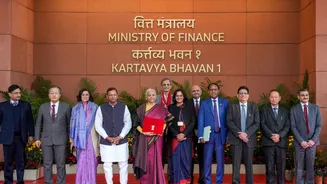
Infra, Manufacturing Push
The Union Budget 2026-27 is geared towards bolstering India's infrastructure and manufacturing sectors. The government's focus is evident in the push for
commercial vehicle demand driven by infrastructure development and the emphasis on cities as development hubs. The budget proposes the rationalisation of employer contributions for PF trusts, and also focuses on boosting the manufacturing sector through various incentives and policy continuity. Additionally, the budget allocates Rs 1342 crore for Mission Mausam and increased funding for pollution control, demonstrating a commitment to sustainable development alongside economic growth. These measures are designed to accelerate economic growth and create a favorable environment for businesses. The budget's emphasis is also extended to rare earth corridors, aiming to boost magnet self-reliance, and enhance the country's manufacturing capabilities.
Fiscal Strategy & Growth
The fiscal strategy outlined in the Union Budget 2026-27 prioritizes fiscal consolidation and broad-based economic growth. The focus on fiscal discipline includes the expectation of Rs 3.16 lakh crore in FY27 from RBI dividends. Simultaneously, the budget has employment at its core, as the government aims to stimulate the economy. The budget underscores a focus on Viksit Bharat and aims for the economic advancement of the nation. The budget also highlights a clear roadmap for growth and MSME support. The budget's emphasis also touches on growth, inclusion, and focuses on creating a stable regulatory environment. Furthermore, the proposals include the extension of the N-Plant import exemption until 2035 and the allocation of Rs 4,869 crore for the Ladakh budget.
Industry Reactions, Initiatives
Various stakeholders have expressed their views on the Union Budget 2026-27, with many welcoming the key initiatives and outlining expectations for growth. Bengal Inc has welcomed key initiatives, while Gujarat business leaders have hailed the Union Budget. Furthermore, the textile stocks surged following budget announcements, indicating positive sentiment within the sector. The logistics industry has shared its reactions, with companies assessing the potential impacts of the budget's proposals. Additionally, Amul welcomed the budget, highlighting the boost for dairy and cooperatives. The Institute of Chartered Accountants of India (ICAI) has also shared its perspective on the stable regulatory environment. The budget includes allocation for forensic schemes, with Rs 1471 crore planned. Wipro's CFO has shared their views, focusing on the AI focus and fiscal targets. The budget is also seen as a roadmap for growth and MSME support.
Sector-Specific Allocations
The Union Budget 2026-27 makes focused allocations for various sectors, including significant provisions for social and economic development. The budget includes a jump in the Skill Ministry's budget, reaching Rs 9,886 crore. It also allocates Rs 3,400 crore for the Minority Affairs Ministry. The focus on healthcare includes an emphasis on mental health and cancer drug development. The budget also gives significant attention to the AYUSH and Nutraceutical ecosystem, fostering momentum in the sector. The budget also focuses on the FMCG sector, with emphasis on MSMEs and rural growth. The budget has a dedicated focus on the farm sector, with tech boosts and vet expansion. Furthermore, there's a proposed home loan interest deduction in the FY27 budget. The budget introduces an amnesty scheme for foreign assets, which provides benefits to specific individuals and organizations.
Tax, Financial Reforms
The Union Budget 2026-27 introduces several financial and tax reforms. It is proposed to overhaul IT tax processes with a focus on reducing litigation and boosting India as a hub. A significant measure is the raising of the duty-free limit to Rs 75,000. Additionally, the budget also aims to rationalise the home loan interest deduction. There are notable changes in the tax landscape, as it may impact various financial institutions and individuals. The budget has also brought up the discussion of no deductions on dividend and MF interests in the upcoming fiscal year. In terms of revenue generation, the budget anticipates ₹14,000 Cr in FY27 from Pan Masala cess. Several financial decisions in the budget are aimed at driving economic growth and fiscal stability, including the budget for the banking panel, and tax sops in the GIFT city.