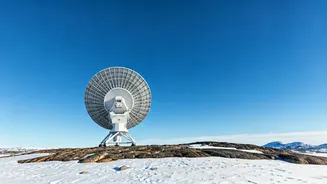

Strategic Geographical Advantages
Greenland's geographic location is a cornerstone of its strategic significance in laser-based satellite communication. Situated in the Arctic, Greenland offers
a prime location for establishing ground stations that can facilitate communication with satellites in polar orbits. These satellites are vital for applications like Earth observation, climate monitoring, and secure military communications. The clear, dry atmosphere prevalent in many parts of Greenland further enhances the effectiveness of laser communication systems, as it minimizes signal interference and attenuation. Moreover, Greenland's relatively stable geological environment provides a reliable base for constructing the necessary infrastructure, which includes the advanced ground stations and sophisticated equipment needed to support these high-tech operations. This unique blend of environmental and geographical factors ensures Greenland’s vital role in optimizing laser communication capabilities in the future.
Infrastructure and Deployment
Deploying and maintaining the necessary infrastructure in Greenland is a complex undertaking, requiring careful planning and substantial investment. Building ground stations in such a remote and harsh environment presents significant logistical challenges, ranging from transportation of equipment to ensuring a stable power supply and skilled labor. However, the investment is justified by the strategic advantages offered. The ground stations themselves consist of advanced optical terminals, high-precision tracking systems, and robust data processing centers designed to handle the massive volumes of data transmitted by laser communication. These systems are also designed to be resilient, capable of withstanding extreme weather conditions and maintaining operations through long Arctic winters. The implementation of robust cybersecurity measures is also critical to protect the sensitive data transmitted via these ground stations.
Laser Communication Technology
Laser communication represents a paradigm shift in satellite data transfer, offering significant improvements over traditional radio frequency communication. Laser systems utilize light beams to transmit data, enabling substantially higher bandwidths and faster data transfer rates. This makes them ideal for applications requiring high-speed data transmission, such as scientific research, real-time video streaming, and rapid data exchange. The technology operates by modulating a laser beam to encode information, which is then transmitted to a receiver on a satellite or another ground station. The accuracy of laser communication depends on the precision of the pointing and tracking systems, which must align the laser beams across vast distances with extreme accuracy. The benefits include enhanced security, as laser beams are more difficult to intercept than radio waves, along with a significantly reduced risk of signal interference.
Advancements and Innovations
Continuous advancements are reshaping laser-based satellite communication, constantly enhancing its capabilities and efficiency. Researchers and engineers are actively exploring novel materials for optical components, developing more powerful and efficient lasers, and creating advanced error-correction codes to improve data reliability. Moreover, there's a strong focus on miniaturizing the technology to reduce the size and weight of satellite communication systems. This allows for the deployment of more compact and cost-effective solutions. Innovations in atmospheric compensation techniques are being developed to mitigate the impact of atmospheric turbulence on laser beam propagation, which leads to more stable and reliable communication links. These ongoing innovations are critical to expanding the use of laser communication and achieving the full potential of high-speed, secure data transfer in space.
Future Prospects in Greenland
Greenland's future in laser-based satellite communication looks exceedingly promising, as its strategic importance continues to grow. As technology matures and the demand for high-speed data transfer increases, the island is expected to play an even more vital role. Greenland could become the hub for a globally interconnected network. Further infrastructure development, including expansion of existing ground stations and the creation of new facilities, is anticipated to support increasing communication demands. Greenland's pristine environment is also well-suited for scientific research, and it may provide an ideal platform for studying the effects of space-based laser communication. With ongoing investments and continuous technological advancements, Greenland is poised to become an essential location for driving innovation in the global satellite communication landscape.









![[WATCH] T20 World Cup 2026: Gautam Gambhir hosts dinner for Team India players ahead of Namibia clash](https://g-mob.glance-cdn.com/public/fc/image/7gXS1xdhs5Q0.webp)