






Elephant's Deep Rumbles
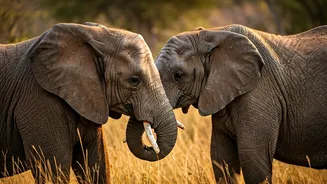
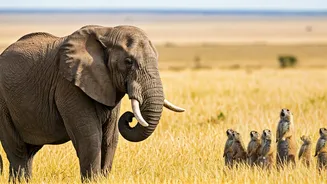
African elephants possess an extraordinary method of communication, employing deep, low-frequency rumbles known as infrasound. These sounds are so powerful
they can travel for several kilometres, both through the ground and the air, allowing entire herds to maintain contact even when spread far apart. This subterranean network of communication is vital for coordinating group movements, warning one another of approaching dangers like predators or human threats, and generally keeping the family unit connected across vast distances. The sheer range and subtlety of these infrasonic calls highlight a sophisticated awareness of their environment and social needs, enabling them to navigate their world and ensure the safety of the collective.
Indri's Rainforest Songs
In the dense rainforests of Madagascar, the indri, a critically endangered lemur species, vocalizes with a series of hauntingly beautiful songs. These melodic calls aren't just for show; they serve as a crucial communication tool for family groups. By singing together in harmonized choruses, indris strengthen their social bonds within the group and effectively mark their territory against rival lemur families. The echoing quality of their songs within the dense foliage allows them to communicate over considerable distances, ensuring that family members can locate each other and maintain cohesion within their arboreal home. This coordinated vocalization is a testament to their complex social structure and territorial awareness.
Kakapo's Mating Booms
The critically endangered kakapo, a large, flightless parrot from New Zealand, employs a unique deep booming call primarily during its mating season. Males produce these resonant sounds to attract females from afar through the nocturnal forest. The effectiveness of these calls in traveling long distances in the dark is essential for successful reproduction, allowing females to pinpoint potential mates and for males to establish their presence and suitability. This specialized vocalization is a key strategy for a species facing significant population challenges, showcasing an adaptation finely tuned to its environment and reproductive needs. The booming sound is a distinctive feature of its communication repertoire.
Narwhal's Arctic Clicks
Often referred to as the 'unicorn of the sea' due to its distinctive tusk, the narwhal is also a master of underwater communication. In the frigid, often visually obscured waters of the Arctic, these whales utilize a rich repertoire of sounds, including clicks, whistles, and pulsed vocalizations. These diverse auditory signals are fundamental for navigating their icy domain, locating prey in the deep ocean, and maintaining social cohesion within their pods. The complexity of their sound production allows for intricate interactions, helping them to coordinate hunting efforts, avoid predators, and strengthen the bonds within their close-knit social groups. Their acoustic world is as vital as sight for their survival.
Prairie Dog's Detailed Warnings
Prairie dogs, small rodents native to North America, exhibit one of the most sophisticated communication systems observed in the animal kingdom. Their alarm calls are remarkably detailed, capable of conveying specific information about an approaching predator. These calls can not only identify the type of threat, such as a hawk, coyote, or even a human intruder, but also communicate its size, speed of approach, and the direction from which it is coming. This level of nuanced information allows other prairie dogs in the colony to react appropriately, whether it's to take cover, prepare for an attack, or simply be more vigilant. Their complex 'language' is a critical survival mechanism.
Sifaka's Multi-Modal Signals
Sifakas, a unique genus of lemurs found exclusively in Madagascar, communicate through a multifaceted approach that combines vocalizations, scent markings, and intricate body language. These arboreal primates rely on a combination of sounds, from chirps to growls, to convey various messages. Complementing their vocal efforts, they use scent glands to mark their territory and communicate their presence or reproductive status. Furthermore, their expressive movements, such as leaps, postures, and facial gestures, play a significant role in coordinating group activities, such as foraging or traversing the forest canopy, and in reinforcing the strong familial bonds that characterize their social structure. This integrated communication strategy ensures their effective navigation and social cohesion.