




The Golden Opportunity
The world faces a monumental challenge with electronic waste (e-waste), accumulating over 60 million tons annually. Much of this discarded technology,
from old laptops to computer motherboards, contains valuable precious metals, including gold, which are often lost in conventional recycling processes. Traditional methods, involving shredding and harsh chemical treatments or high temperatures, are energy-intensive and environmentally taxing. However, a groundbreaking discovery by Swiss scientists offers a novel and sustainable alternative. They have found a way to harness a common byproduct of the food industry—whey, a liquid leftover from cheese production—to selectively extract pure gold from these electronic components. This innovative technique not only addresses the escalating e-waste problem but also provides a potentially lucrative and environmentally conscious avenue for resource recovery.
Whey Proteins: The Gold Sponges
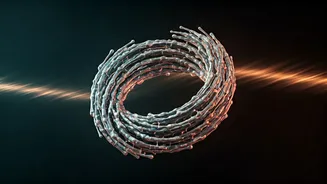
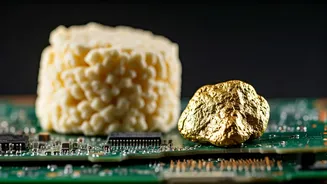
Researchers, led by Professor Raffaele Mezzenga at ETH Zurich, have developed a remarkable process centered around whey proteins. Initially, these proteins are heated in an acidic solution, causing them to form tiny, thread-like structures known as amyloid fibrils. These fibrils then aggregate into a gel-like substance. When this gel is dried, it transforms into a highly porous material resembling a 'protein sponge.' This sponge possesses an enormous surface area, making it exceptionally adept at capturing specific metal ions. In their experiments, the scientists took discarded motherboards, dissolved their metallic components in acid, and then immersed the protein sponge. The sponge selectively bonded with gold ions, leaving behind other metals like iron, aluminum, and copper. This selective adsorption is the key to isolating the gold efficiently.
From Sponge to Nugget
Once the protein sponge has absorbed the gold ions, the next step is to convert these captured ions into solid gold. The researchers achieve this by heating the gold-laden sponge. This thermal process causes a reduction reaction, transforming the gold ions into metallic gold particles. These particles then coalesce, melting into small nuggets of pure gold. In laboratory tests using 20 scrapped motherboards, this method successfully yielded approximately 450 milligrams of gold per motherboard, with the resulting gold being 91% pure, mixed with 9% copper. Professor Mezzenga highlighted the elegance of this approach, emphasizing the use of a food industry byproduct to reclaim valuable materials from electronic waste, underscoring its economic viability and environmental benefits.