




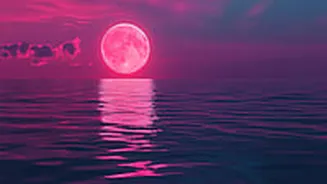
The Pink Moon's Arrival
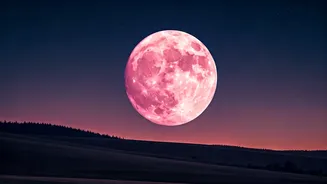
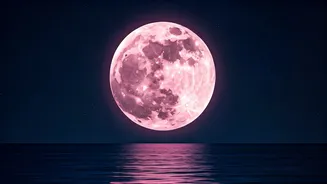
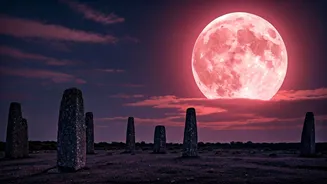
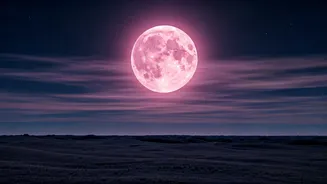
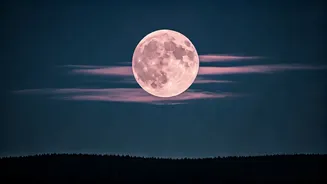
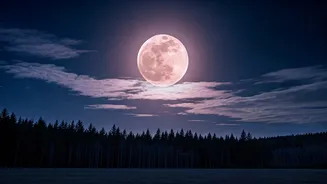
As spring unfolds, the night sky is set to present a captivating sight: April's first full moon, affectionately known as the 'Pink Moon.' This lunar occurrence
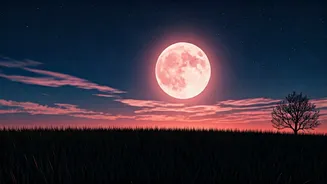
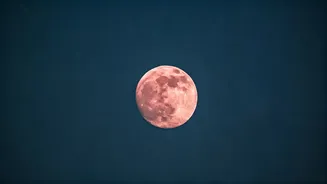
is scheduled to reach its zenith of brightness on April 2nd. However, for those eager to witness its most dramatic visual impact, the preceding evening, April 1st, is the prime opportunity. As the moon begins its ascent above the horizon, it will likely present a captivating hue, often appearing more golden or orange than pink due to how our atmosphere filters sunlight. This particular full moon also plays a crucial role in determining the timing of significant religious observances such as Easter and Passover.
Beyond the Name
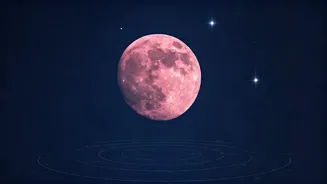
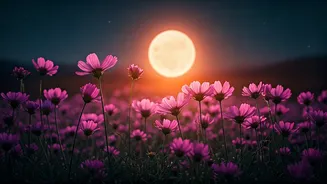
Contrary to what its name might suggest, the 'Pink Moon' does not actually manifest as a pink celestial body. The title originates from ancient traditions, particularly among early Native American tribes in North America. These communities utilized the lunar cycles to track the progression of seasons. They bestowed the name 'Pink Moon' upon this particular full moon to commemorate the vibrant pink wildflowers, such as the wild ground phlox, that traditionally carpeted the landscape during the early spring months. Thus, the name is a historical nod to the blooming flora rather than the moon's actual color, which is more commonly observed as shades of orange, copper, or golden yellow.
The Science of Color
The intriguing coloration observed during the 'Pink Moon' is a result of fundamental atmospheric optics. When the moon is positioned low on the horizon, the light reflecting from its surface must traverse a significantly longer path through Earth's atmosphere before reaching our eyes. Our atmosphere is filled with particles that interact with light. Shorter wavelengths, such as blue and violet, are scattered in various directions as they pass through this atmospheric veil. Conversely, the longer wavelengths—reds, oranges, and yellows—are less affected and can penetrate the atmosphere more effectively. This selective filtering process is what imbues the low-hanging moon with its characteristic warm, coppery, or golden glow, a phenomenon similar to the breathtaking colors seen during sunrises and sunsets.
A Stellar Companion
Adding an extra layer of wonder to this month's lunar event, the 'Pink Moon' will be accompanied by a brilliant celestial neighbor. Positioned remarkably close to the full moon will be an exceptionally bright point of light. This is not an ordinary star, but rather Spica, a dazzling binary star system that resides within the Virgo constellation. The proximity of Spica to the illuminated moon creates a visually striking tableau in the night sky, offering amateur astronomers and casual observers alike a delightful celestial pairing to admire. This conjunction enhances the overall spectacle of the night sky, making the viewing experience even more memorable.
Holiday Significance
Beyond its aesthetic appeal, the 'Pink Moon' holds considerable cultural and religious importance, directly influencing the dates for major holidays. The timing of Easter is determined by an ancient Christian calculation: it is always celebrated on the first Sunday following the first full moon that occurs after the vernal equinox. Since the astronomical spring equinox fell on March 20th this year, this April full moon serves as the crucial marker, officially setting the date for the upcoming Easter celebration. Similarly, the Jewish festival of Passover also aligns with lunar cycles, further underscoring the 'Pink Moon's' role in marking significant religious observances.
Navigating the Weather
As with any outdoor astronomical event, the visibility of the 'Pink Moon' is subject to meteorological conditions. For skywatchers in the UK, the forecast presents a mixed outlook. Regions like England and Wales may experience challenges due to expected heavy cloud cover and intermittent rain on the evening of April 1st, potentially obscuring the view. In contrast, Scotland and Northern Ireland are anticipated to benefit from colder air masses, offering a higher probability of clear skies and uninterrupted viewing opportunities. Regardless of the specific conditions, taking a moment to observe the moon as it rises is encouraged as a way to connect with the changing seasons.