





Cryogenic Core
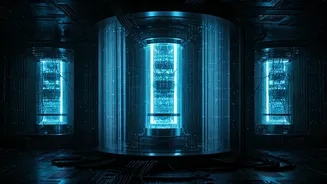
At the heart of a quantum computer lies a processor that operates at incredibly frigid temperatures, around 10 millikelvin – colder than deep space. This
essential component, often no larger than a soda can, is housed within a sophisticated refrigeration system. This isn't just any refrigerator; it's a dilution refrigerator, a marvel of engineering designed to reach these extreme low temperatures. It utilizes the quantum properties of helium isotopes, specifically a mixture of helium-3 and helium-4. The cooling process is continuous, driven by the energy required for helium-3 to move between different phases, a process that absorbs heat from its surroundings. Modern systems typically start with mechanical cryocoolers bringing the temperature down to around 50 Kelvin, then to 4 Kelvin, before the dilution cycle takes over to achieve the final millikelvin range. While a lab-scale setup might consume 5 to 10 kilowatts, large-scale data centers require significantly more power for advanced cooling stages and redundancy, ensuring operational stability for thousands of qubits and extensive control lines.
Classical Control Nexus
The quantum processing unit (QPU) cannot operate in isolation; it requires a robust classical control layer. Superconducting quantum processors rely on a method where microwave pulses, generated by room-temperature electronics, are sent to each qubit via coaxial cables. However, this approach faces scalability challenges due to the limited number of available cables, dictated by the refrigerator's cooling capacity and available space. Each qubit necessitates precise microwave signals for both performing operations and for readout. Consequently, the classical control electronics often consume more space and energy than the quantum chip itself. To address this, significant efforts are underway to bring control electronics closer to the qubits. Innovations like cryogenic control chips are being developed to house essential control functions within the refrigerator, operating at temperatures as low as 4 Kelvin or even alongside the qubits at millikelvin temperatures. These advancements are crucial for enabling denser qubit arrays and more efficient control mechanisms, moving away from linear scaling limitations.
Bridging Quantum and Classical
Integrating quantum processing units (QPUs) with traditional CPUs and GPUs in high-performance computing (HPC) environments is a critical area of development. Reference architectures outline a three-tiered system based on proximity and latency: the quantum system itself, a classical runtime with FPGAs and ASICs for low-latency tasks like mid-circuit measurements, and scale-up systems connected via near-time interconnects. For broader processing needs, scale-out systems link CPU and GPU clusters through high-bandwidth connections. This hybrid approach is already being realized, with quantum systems co-located with supercomputers and linked at the instruction level via high-speed networks. This enables parallelized workloads and sophisticated classical-quantum communication protocols, facilitating unbroken data exchange for complex simulations. The software layer is equally vital, with platforms designed to manage this handoff, enabling the development of quantum applications and facilitating real-time control and error correction between QPUs and GPUs.
Data Center Integration
While the physical footprint of a quantum system is relatively modest compared to classical AI infrastructure, its integration into existing data centers presents unique challenges. A quantum machine drawing around 30 kilowatts is significantly less power-intensive than a rack of high-end AI chips. However, the specialized requirements of the dilution refrigerator necessitate careful consideration. Vibration isolation is paramount to prevent external disturbances from affecting the delicate qubits. Furthermore, the control and readout cables act as conduits for heat, even microwatt-level heat can destabilize the system. Companies are actively designing solutions to overcome these hurdles, focusing on creating faster, smaller, and digitally controlled QPUs that can fit into data center form factors. The future points towards hybrid systems where CPUs, GPUs, and QPUs collaborate seamlessly. Integration is envisioned in phases, starting with QPUs as co-processors, progressing to tightly coupled quantum and classical resources, and ultimately leading to co-designed unified platforms, signifying a shift from speculative concepts to tangible data center architectures.