





Lunar Cycles & Daylight Visibility
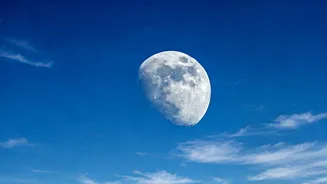
The Moon's presence in our daytime sky is a natural consequence of its orbit around Earth and its illuminated phases. Due to the Earth's rotation, the Moon rises
and sets approximately 50 minutes later each night. This consistent shift means that depending on its phase, the Moon can be positioned advantageously to be seen alongside the Sun. For instance, a first quarter Moon, which is half illuminated on its right side, rises around noon and sets near midnight. This positioning makes it readily observable in the afternoon sky. Conversely, a last quarter Moon, half illuminated on its left, emerges in the sky after midnight and remains visible for some time after sunrise. Therefore, the Moon isn't exclusively a nocturnal sight; it occupies our sky for roughly half of each month during daylight hours.
Spotting the Moon & Jupiter
This week offers a prime opportunity to observe the Moon in the daytime, with a waxing crescent phase beginning around April 22nd. To find it, look towards the eastern horizon at midday. The Moon will be approximately 30% illuminated, with its lower portion obscured by shadow, appearing as a delicate crescent. A remarkable celestial event accompanies this sighting: the planet Jupiter will be visible as a steady point of light situated about 5 degrees below the lunar crescent. This separation is roughly equivalent to the width of three middle fingers held at arm's length. While the Moon itself is easily visible to the naked eye, spotting Jupiter in the bright glare of the daytime sky might necessitate the use of binoculars for a clearer view. The Moon follows a broad arc across the daytime sky before descending towards the southwestern horizon at sunset.
Daytime Celestial Brightness
The Earth's Moon stands out as one of the few celestial bodies consistently bright enough to be perceived against the sunlit atmosphere. While the Sun's overwhelming radiance typically obscures fainter objects, the Moon, along with exceptionally luminous planets like Venus and Jupiter, can still be discerned. The sheer brilliance of the Sun saturates our atmosphere from dawn till dusk, effectively masking the distant stars and nebulae. However, the Moon's proximity and significant reflectivity allow it to remain visible for extended periods during daylight hours. This week’s extended visibility runs from April 22nd until the approach of the full moon phase on May 1st, presenting ample opportunities for daytime observation.
Safe Daytime Telescopic Viewing
Observing the Moon through a telescope or binoculars during the day is entirely safe for your eyesight, provided you adhere to one crucial safety rule: never, under any circumstances, point your optical instrument directly at the Sun. Doing so can result in immediate and irreversible vision damage. To ensure safety, it is advisable to position your telescope in a shaded area. Utilize a large object, such as a building, to block your direct line of sight to the Sun. Vigilantly monitor the Sun's position as it travels across the sky towards the western horizon throughout the day. With appropriate precautions, daytime viewing with magnification can reveal stunning details. You can easily discern the dark expanses of the lunar maria, or 'seas,' which are remnants of ancient lava flows. A telescope will also enhance the visibility of dramatic shadows cast across craters, particularly those situated near the terminator—the dividing line between lunar day and night.