



Amritsar to Attari: Border Bound
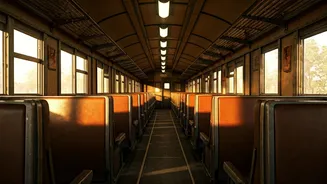
Embark on a brief yet significant 25-kilometer train journey from Amritsar to Attari, a trip that takes approximately 40 to 45 minutes and costs a mere
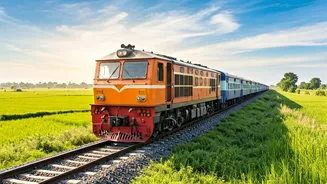
₹10. This route, which includes stops at Chheharta and Khasa, culminates at Attari, a station situated remarkably close to the India-Pakistan border. Historically, this very track served as a vital connection to Lahore before the partition of India, hinting at a past where the border did not divide these vibrant cities. The landscape outside the train windows transforms into expansive green fields dotted with small, traditional villages, offering a peaceful contrast to urban life. Keep an eye out for Border Security Force training exercises near Khasa, a reminder of the region's strategic importance. Attari station itself stands as a testament to colonial architecture, once bustling with trains that traversed between India and Pakistan. While the primary draw for many is the renowned Attari-Wagah border ceremony, the vicinity also offers explorations into Sarai Amanat Khan village, the historical Pul Kanjri constructed by Maharaja Ranjit Singh, and Sham Singh Attari Park, which houses a museum honoring the Sikh general. Train services typically run twice daily, departing Amritsar at 7:30 AM and 6:20 PM, with return journeys from Attari scheduled for 8:20 AM and 7:15 PM.
Amritsar to Dera Baba Nanak: Spiritual Serenity
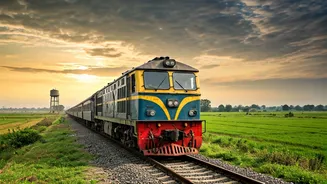
The route extending from Amritsar to Dera Baba Nanak covers a distance of about 55 kilometers, requiring a travel time of roughly 1 hour and 20 minutes, with ticket prices set at an economical ₹15. Along this path, the train makes several stops, including Verka, Majitha, Ramdas, Rattar Chattar, and Hardowal, before reaching the historically significant town of Dera Baba Nanak in the Gurdaspur district. The stations encountered on this journey are characterized by their charming colonial-era architectural style, often adorned with vibrant bougainvillea flowers. Verka station, in particular, evokes the ambiance of a picturesque hill station bungalow, while Hardowal presents a tranquil rural setting. As the train glides through the countryside, passengers are treated to views of cultivated farms, local farmers diligently working the land, and tractors navigating the fields. Dera Baba Nanak holds profound religious significance, being associated with the final years of Guru Nanak Dev Ji's life. This town is situated across the Ravi River from Kartarpur in Pakistan, which is home to the revered Gurdwara Darbar Sahib Kartarpur. A key attraction in Dera Baba Nanak is the commencement point of the Kartarpur Corridor. This corridor, when operational, enables Indian Sikh pilgrims to visit the Gurdwara Darbar Sahib in Pakistan without the need for a visa. Beyond the corridor, visitors can explore the Darbar Sahib gurdwara, Sri Chohla Sahib, and the local marketplace. Train services are frequent, with departures from Amritsar or Verka to Dera Baba Nanak at 4:20 AM, 10:30 AM, 2:15 PM, and 5:50 PM, and return services from 6:05 AM, 12:15 PM, 4:00 PM, and 7:20 PM.
Amritsar to Khem Karan: Echoes of War
Representing the most extensive of the three routes, the journey from Amritsar to Khem Karan spans 77 kilometers and requires approximately two hours for completion, with a ticket price of ₹20. Some services for this route commence from Bhagtanwala station, located near Amritsar. The train navigates through numerous small railway halts within the Taran Taran district, providing an intimate perspective of rural life in Punjab. Khem Karan carries substantial historical weight, primarily as the site of the pivotal Battle of Asal Uttar during the 1965 Indo-Pakistani War. It was here that Indian forces successfully repelled a significant Pakistani armoured offensive, an event that led to numerous abandoned tanks littering the battlefield, earning it the moniker "Graveyard of Tanks." Within close proximity to the international border fence, visitors can discover two unique spiritual sites: Gurdwara Sahib Singh Shaheed and Sheikh Braham Dargah. Access to these shrines necessitates passing through Border Security Force (BSF) checkpoints. Strict security protocols are in place, including the mandatory deposit of electronic devices like mobile phones and cameras, and photography is prohibited in the vicinity. Train timings for the Amritsar/Bhagtanwala to Khem Karan route are typically at 4:40 AM, 9:15 AM, 1:35 PM, and 6:10 PM, with return journeys from Khem Karan scheduled for 6:50 AM, 11:25 AM, 3:35 PM, and 8:10 PM.
Cinematic Views & Winter Charms
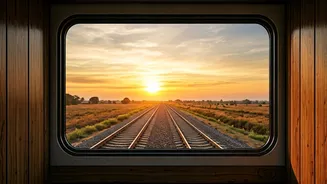
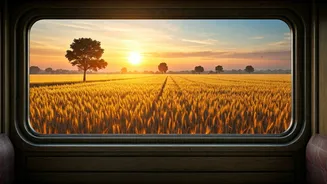
Beyond their historical and scenic appeal, these railway lines have also captured the imagination of Indian cinema. The Amritsar-Attari route, in particular, has served as a backdrop for films that explore themes of connection and separation. The tracks were famously featured in 'Bajrangi Bhaijaan,' highlighting the emotional ties that transcend borders, while Attari station itself was a filming location for 'Veer-Zaara,' a story centered on love across the India-Pakistan divide. The quiet ambiance of Attari station and the existence of the closed railway line at the frontier continue to evoke a sense of nostalgia and remembrance. Similarly, the modest railway station at Dera Baba Nanak has made its mark on screen, notably in 'Gustaakh Ishq,' which celebrated the charm of small-town Punjab and its vintage railway architecture. Traveling these routes during the winter months, especially in December, offers a particularly enchanting experience. Early mornings are often enveloped in dense fog that softens the vast farmlands around Amritsar and Attari into a serene palette of greys and greens. As the train progresses, the unfolding panorama of open fields, distant hamlets, and expansive skies creates a tranquil visual narrative outside the windows.