

Ocean Depths From Orbit
For decades, humanity has possessed detailed maps of celestial bodies like the Moon, yet vast expanses of our own planet's ocean floor remain largely uncharted
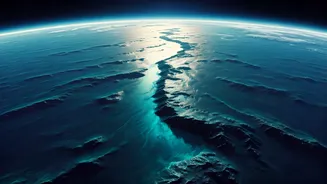
territory. This disparity is beginning to change, thanks to a groundbreaking initiative by NASA. The US space agency has introduced a novel map of the ocean floor, meticulously compiled using data acquired from its vantage point in space. This ambitious project is a crucial component of a larger, ongoing effort aimed at creating a comprehensive and highly detailed map of the entire seabed by the close of this decade. The Surface Water and Ocean Topography (SWOT) satellite, a collaborative venture between NASA and the French Centre National d'Études Spatiales (CNES), is at the forefront of this endeavor. Launched in December 2022, this advanced satellite orbits our planet, capable of surveying approximately 90 percent of Earth's surface within a mere 21-day cycle. Its unique approach bypasses direct seafloor imaging, instead employing an ingenious method of measuring subtle fluctuations in water levels across oceans, lakes, and rivers, thereby inferring the topography hidden beneath.
Gravity's Role in Mapping
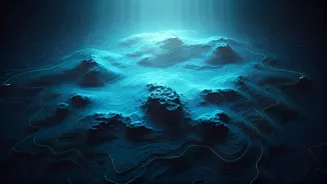
The ingenious technique employed by the SWOT satellite to map the ocean floor hinges on the fundamental force of gravity. Submerged geological formations, such as underwater mountains and expansive hills, possess a greater mass than the surrounding seafloor. This increased mass exerts a slightly stronger gravitational pull on the water directly above them. The consequence of this enhanced gravitational attraction is the formation of minuscule bulges or elevated areas on the ocean's surface. By meticulously analyzing these subtle undulations in the water, scientists are able to deduce and reconstruct the underlying topography of the seafloor. David Sandwell, a geophysicist at the Scripps Institution of Oceanography, highlights the significance of the SWOT satellite, stating it represents a substantial advancement in our capacity to map the seafloor. While prior satellite technologies were limited to detecting colossal features, such as seamounts exceeding one kilometer in height, SWOT's superior sensitivity allows it to identify features less than half that size, offering a dramatically more granular visualization of the ocean floor. This increased detail leads researchers to anticipate a significant increase in the number of recognized seamounts, potentially rising from an estimated 44,000 to as many as 100,000.
Why Seafloor Mapping Matters
Understanding the topography and features of the ocean floor is of paramount importance for a diverse array of reasons. Accurate seafloor maps are instrumental in enhancing the safety and efficiency of maritime navigation and shipping routes, ensuring vessels can traverse the seas with greater predictability. Furthermore, this knowledge is crucial for the practical undertaking of laying vital underwater communication cables, which form the backbone of global connectivity. Identifying potential underwater hazards, such as submerged obstacles or unstable terrain, is also a critical benefit derived from detailed seafloor mapping. Beyond these immediate practical applications, a profound understanding of the seabed plays an indispensable role in the scientific study of ocean currents, the dynamics of tides, and the intricate workings of marine ecosystems. Additionally, mapping the seabed provides invaluable insights into the complex processes of plate tectonics and offers a clearer picture of how Earth's surface has evolved and continues to change over geological timescales. This comprehensive mapping effort contributes to a more holistic understanding of our planet.
Towards a Global Seafloor Atlas
The ongoing work utilizing data from the SWOT satellite is an integral part of a much larger, concerted international effort dedicated to mapping the entirety of the Earth's seafloor by the year 2030. While traditional methods involving ships equipped with advanced sonar technology remain essential for acquiring the most precise and high-resolution measurements, satellites like SWOT offer an unparalleled capability to survey immense geographical areas with remarkable speed. This orbital perspective allows for the rapid collection of data across vast stretches of ocean that would be impractical or time-consuming to cover with surface vessels alone. David Sandwell explains that while the complete, ship-based mapping may not be fully accomplished by the 2030 deadline, SWOT's contribution will be vital in filling the gaps and significantly advancing progress towards achieving the objective. As an ever-increasing volume of data is gathered and subjected to rigorous analysis, scientists anticipate further refinements and improvements to the existing maps. For the present, this innovative space-based approach represents a significant leap forward in our collective endeavor to illuminate one of Earth's last great frontiers of exploration – its mysterious and largely unknown ocean depths.