
Rupee's Tumultuous Journey
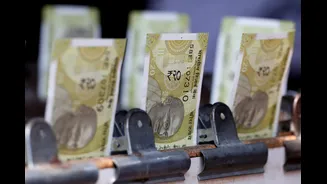
The value of the Indian rupee, like any currency, fluctuates depending on a multitude of factors, all contributing to its strength or weakness against
other currencies, specifically the US dollar. These fluctuations, often referred to as exchange rate volatility, are a constant feature of the global financial market. This volatility is influenced by several elements, among them trade imbalances, where the amount of goods and services a country imports versus exports plays a huge role. When a country imports more than it exports, more domestic currency is often needed to buy foreign currency to pay for the imports, which can potentially weaken the rupee's value. Inflation rates also have a significant impact; higher inflation relative to the US often puts downward pressure on the rupee. Investors' perception of economic growth and stability also impacts the rupee. Positive indicators, such as a growing GDP, can attract foreign investment, increasing the demand for the rupee. Conversely, any economic uncertainty can lead to capital outflow and a weakening rupee.
Dollar's Dominant Position
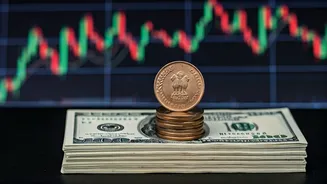
The US Dollar (USD) frequently acts as a benchmark against which other currencies are measured, including the Indian Rupee (INR). The USD's strength, or conversely, the weakness of the INR, is influenced by the US Federal Reserve's monetary policy, which includes setting interest rates. Higher interest rates in the US typically attract investment, strengthening the USD, and creating some pressure on other currencies like the INR. Global economic conditions affect the USD's standing; during periods of economic uncertainty, the USD often becomes a safe-haven asset, increasing its value. This, in turn, can cause the INR to depreciate against the dollar. Moreover, the USD's global influence in international trade, especially in the oil markets, significantly impacts the demand for dollars, influencing exchange rates. A significant portion of international trade and oil transactions are conducted in USD, enhancing its dominant position and affecting the INR's value.
GDP and Rupee Connection
A country's Gross Domestic Product (GDP), a key indicator of economic health, frequently influences the value of its currency. A robust GDP generally indicates strong economic performance, potentially attracting foreign investment and increasing the demand for the domestic currency, which could appreciate the rupee. Conversely, a declining GDP might discourage foreign investment, which could weaken the rupee. However, this relationship is not always straightforward. Other factors, like inflation, trade balance, and government policies, also affect the rupee. The composition of GDP growth matters, too. For instance, growth driven by sustainable sectors can have a more positive impact on the rupee's value than that driven by unsustainable sectors. Additionally, the government's fiscal and monetary policies can counteract the influence of GDP. For example, measures to control inflation or to attract foreign investment can buffer or alter the immediate impacts of GDP on the rupee.
External Factors' Influence
External factors, beyond the Indian government's direct control, have a significant impact on the rupee's value. Global economic trends, such as recessions or periods of growth in major economies, affect the rupee. Strong growth in major trading partners often enhances demand for Indian exports, potentially strengthening the rupee. Conversely, a global economic slowdown can harm exports, which could weaken the rupee. Commodity prices, particularly oil, also play a huge role. India, being a major importer of crude oil, experiences increased costs when oil prices rise, which can widen the trade deficit and weaken the rupee. Geopolitical events, like political instability or conflicts, can create uncertainty in financial markets. This can lead to investors seeking safer assets, potentially weakening the rupee. Lastly, foreign capital flows, including investments from foreign institutional investors, have a direct impact. Large inflows can strengthen the rupee, while outflows can weaken it.
Strategies for Resilience
India has several strategies to manage and stabilize the rupee against external shocks. Foreign exchange reserves, which are held in foreign currencies, act as a buffer and provide the central bank with the means to intervene in the currency market, buying or selling rupees to influence its value. Monetary policy adjustments, such as changing interest rates, are used to manage inflation and capital flows. Higher interest rates can attract foreign investment and strengthen the rupee, but they can also slow down economic growth. Fiscal policies, including government spending and taxation, also play a crucial role. Measures to reduce the fiscal deficit, for example, can enhance investor confidence and support the rupee. Diversification of trade partners, to reduce dependence on any single economy, can also help to mitigate the impact of global economic fluctuations. Furthermore, promoting exports and attracting foreign direct investment (FDI) can increase the supply of foreign currency and help to stabilize the rupee's value.