





Hidden Galactic Streams
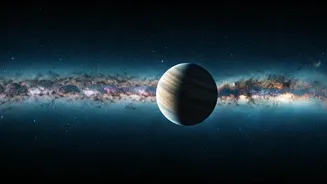
Astronomers have identified a multitude of previously unknown star streams encircling our Milky Way galaxy. These celestial rivers are remnants of smaller
galaxies and star clusters that have been gravitationally disrupted and absorbed by our own galaxy over billions of years. The discovery, made through advanced observational techniques and data analysis, significantly expands our understanding of galactic evolution and the dynamic history of the Milky Way. These faint, diffuse structures are often found in the galaxy's outer reaches, making them difficult to detect against the backdrop of background stars. Their identification provides crucial clues about the Milky Way's formation process and its interactions with its cosmic neighbors, painting a richer picture of our galactic home.
Artemis II: A New Dawn
The Artemis II mission signifies a monumental step in human space exploration, bringing us closer to returning astronauts to the Moon. For an Apollo historian, witnessing the Artemis II mission offered a profound connection to humanity's past achievements in space. The mission's 'Earthrise' moment, mirroring the iconic imagery captured during the Apollo era, evokes a sense of wonder and continuity. This mission serves as a vital precursor to future lunar landings and, ultimately, Mars exploration. It represents not just a technological feat but an emotional and historical echo, allowing those who chronicled the first lunar voyages to experience a new chapter of lunar ambition firsthand, bridging generations of space endeavors.
Supergiant Exoplanet Origins
The James Webb Space Telescope (JWST) has provided a critical clue in understanding how enormous gas giant exoplanets come into being. Researchers, using the JWST's advanced infrared capabilities, have observed young galaxies exhibiting surprisingly rapid aging, akin to '2-year-olds acting like teenagers.' This suggests that the conditions necessary for forming massive planets might arise much earlier in the universe's timeline than previously thought. The observations indicate that the processes governing stellar and planetary formation in these nascent galaxies are accelerated. This finding challenges existing models and opens new avenues for research into the diverse mechanisms that lead to the creation of the largest planets beyond our solar system.
Hubble Tension Solved?
The perplexing 'Hubble tension,' a discrepancy between measurements of the universe's expansion rate derived from early and late universe observations, may finally have a solution. New research suggests that ripples in spacetime could provide the key to reconciling these differing values. These spacetime ripples, potentially influenced by exotic physics or gravitational waves, might be subtly altering our measurements of cosmic distances and expansion. The ongoing quest to accurately determine the universe's expansion rate is fundamental to understanding its ultimate fate and evolution. This potential breakthrough, spurred by advancements in observational cosmology and theoretical physics, promises to refine our cosmic roadmap.
Mapping the Dark Universe
Astronomers are employing innovative techniques to unveil the 'skeleton' of the universe, referring to the large-scale cosmic web structure dominated by dark matter and dark energy. Recent advancements, including massive 3D maps of the universe and detailed observations from the James Webb Space Telescope (JWST), are providing an unprecedentedly clear picture of these elusive components. By studying the distribution of galaxies and the gravitational lensing effects they produce, scientists are piecing together the underlying scaffolding that shapes the cosmos. The JWST's view of 800,000 galaxies is particularly instrumental, offering a detailed map of dark matter distribution. These efforts are crucial for understanding the fundamental forces governing cosmic evolution and structure formation.
ISS Astronauts' Playful Moment
In a lighthearted moment captured aboard the International Space Station (ISS), NASA astronauts engaged in a playful experiment involving an optical illusion. This image, shared as a space photo of the day, offers a glimpse into the human element of spaceflight, showcasing the camaraderie and ingenuity of those living and working in orbit. Such instances highlight that even in the demanding environment of space exploration, astronauts maintain a sense of humor and find creative ways to interact and relieve stress. These personal moments, alongside the critical scientific research, underscore the multifaceted nature of human presence in space and contribute to public engagement with space missions.
Rapidly Aging Galaxies
The James Webb Space Telescope has made a startling discovery: young galaxies in the early universe are aging at an astonishingly rapid pace, a phenomenon described as 'it's like seeing 2-year-old children act like teenagers.' This implies that the processes of star formation and galactic evolution were far more vigorous and condensed in the universe's infancy than previously understood. These early galaxies are not only forming stars at exceptional rates but also developing complex structures much faster than anticipated by current cosmological models. This revelation challenges our understanding of cosmic timescales and suggests a more dynamic and accelerated early universe, requiring a reevaluation of how galaxies mature and evolve over cosmic epochs.
Space Combat Doctrine
The assertion that space combat was 'critical to mission success' in the US war in Iran, as stated by a Space Force chief, highlights the evolving role of space assets in modern warfare. This declaration underscores the increasing reliance on space-based capabilities for reconnaissance, communication, and potentially offensive or defensive actions. It suggests that control and dominance in the space domain have become integral to achieving strategic objectives on Earth. The statement implies a shift in military doctrine, recognizing space not just as a domain for observation but as an active theater of operations where conflict can be waged and won, impacting terrestrial outcomes significantly.
Black Hole Alternatives?
A compelling theory posits that the supermassive black hole at the Milky Way's center might not be a black hole at all, but rather a dense clump of dark matter. This groundbreaking idea challenges conventional astrophysical understanding, suggesting that the observed gravitational effects attributed to a black hole could be explained by the concentrated mass of dark matter particles. If true, this would have profound implications for our comprehension of black hole formation and the nature of dark matter itself. This hypothesis offers an alternative explanation for phenomena currently attributed to black holes, potentially revolutionizing our understanding of galactic cores and the elusive dark universe.
The Universe's Blueprint
Astronomers have successfully unveiled the largest 3D map of the universe ever created, a monumental achievement that illuminates 'hidden' cosmic structures. This intricate map charts the distribution of galaxies and matter across vast cosmic distances, revealing the underlying web-like framework of dark matter that shapes the cosmos. By meticulously cataloging hundreds of thousands of galaxies, scientists have gained unprecedented insight into the large-scale structure of the universe, including the voids and filaments that define its architecture. This detailed visualization is crucial for testing cosmological models and understanding the interplay between visible matter, dark matter, and dark energy in shaping the universe we observe.