





Ambitious Orbital Illumination
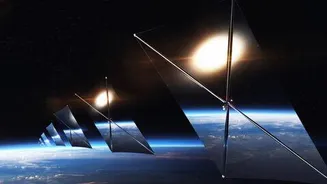
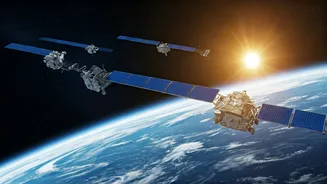
A fledgling space venture has put forth a truly audacious proposition: to dot Earth's orbit with an astonishing 50,000 mirrors by the year 2035. The ultimate
goal is to redirect sunlight, effectively turning night into day for specific regions on our planet, akin to a colossal celestial spotlight. This company, which has already secured a substantial $28 million in funding and initiated the process with the FCC for a preliminary prototype, is pushing the boundaries of what's technologically conceivable. However, as this bold Silicon Valley ambition reaches for the stars, a chorus of scientific voices is rising, sounding urgent warnings about the potential repercussions when grand visions clash with the unyielding principles of orbital physics and terrestrial ecology.
The Mirror Math Problem
The core challenge lies in the energy output versus the sheer scale of investment required. Even with mirrors of immense size deployed in orbit, the energy they can realistically deliver back to Earth's surface proves to be a remarkably modest return for the colossal infrastructure expenditure. The company's initial prototype, a unit roughly the size of a dorm refrigerator, unfolds to reveal a mirror spanning 60 feet. This impressive structure is designed to illuminate an area of approximately three square miles, achieving a brightness comparable to a full moon. Yet, upon closer examination of the energy calculus, the proposition becomes less compelling. Each of the planned 180-foot production mirrors is projected to deliver only a minuscule fraction – about 1/140,000th – of the intensity of direct midday sunlight, and this illumination would be spread across a considerable 18 square miles. Compounding these figures, research from Monash University suggests that over 3,000 such satellites would need to operate in unison to achieve a mere 20% of daytime solar intensity at any given terrestrial location. This harsh reality makes the company's proposed $5,000-per-hour service fee seem both potentially justifiable and utterly impractical. Historical attempts to replicate similar concepts have also encountered insurmountable physical limitations, with past Russian experiments, while briefly illuminating Arctic zones with an 80-foot mirror, underscoring the fundamental physics constraints that have not been overcome. The phenomenon of light scattering inherently prevents the beam from being precisely contained, leading to unintended sky brightening far beyond the targeted recipient.
Astronomers' Grave Concerns
The widespread deployment of such orbital mirrors poses a significant threat to ground-based astronomy, potentially leading to permanent pollution of the night sky with artificial illumination that could surpass the brightness of moonlight. Experts like Robert Massey from the Royal Astronomical Society have voiced strong opposition, describing the idea as 'terrible.' The concern is that 50,000 reflective surfaces moving across the sky would create continuous streaks within telescope images, rendering astronomical observations extremely difficult, if not impossible. Beyond scientific endeavors, the implications extend to aviation safety, with pilots potentially facing hazardous distractions from sudden, bright flashes in their field of vision. Furthermore, the natural world would be profoundly impacted, as wildlife relies on the consistent patterns of night and day for their circadian rhythms, which govern crucial activities such as migration, breeding, and hibernation. The current regulatory framework presents another significant hurdle. Agencies like the FCC primarily review concerns related to radio interference and the eventual disposal of satellites, but they largely overlook the environmental consequences. Alarmingly, no federal body is currently tasked with assessing the potential ecological effects or the impact on the preservation of the night sky from infrastructure that would be visibly present from space, a notable deficiency for such a far-reaching project.
Physics Trumps Funding
Despite attracting substantial interest, including over 250,000 service applications and contracts from the Air Force, the proposed technology is ultimately constrained by the immutable laws of physics. The practicality of orbital mirrors for global energy solutions is questionable when compared to existing, more efficient technologies. Battery storage systems and grid-scale solutions are already adept at extending the utility of solar power far more effectively than a complex orbital infrastructure that would necessitate continuous satellite replacement. While these mirrors might find specific, limited applications, such as aiding in disaster relief efforts or supporting operations in the Arctic, their potential to fundamentally alter global energy supply is severely limited. The mathematical feasibility for such a grand undertaking simply does not align with the scientific realities. This situation highlights a critical juncture in space commercialization, where the boundless optimism of startups confronts the unyielding constraints of orbital mechanics and environmental impact, leaving the future of the night sky hanging precariously in the balance.