





Launch and Initial Ascent
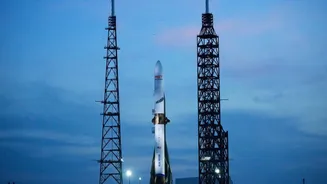
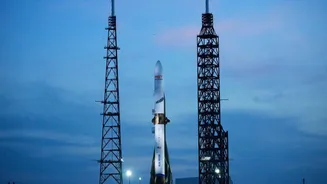
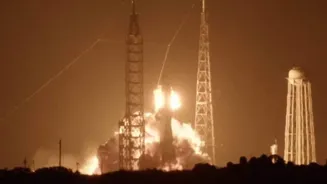
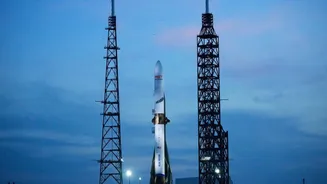
The Starship rocket embarked on its latest journey from SpaceX's Texas facility, powered by an impressive 18 million pounds of thrust from 33 Raptor 3 engines.
This marked a significant upgrade from previous iterations, featuring two additional engines in its first stage. However, the ascent wasn't entirely smooth, as one of the 33 engines experienced an early shutdown approximately one minute and 40 seconds into the flight. Despite this hiccup, the booster successfully completed its designated phase, paving the way for the second stage to initiate its crucial 'hotstaging' sequence. This maneuver involves the upper stage's six Raptor engines igniting just before the booster separates, with exhaust venting through a specific strut ring connecting the two components. This complex sequence is vital for ensuring a clean separation and continued progress towards orbit.
Booster's Descent Issues
Following its separation, the Starship booster faced further complications during its descent phase. The engines intended to reignite for a controlled landing and splashdown in the Gulf of Mexico failed to activate. SpaceX commentators noted an 'early boostback shutdown,' indicating a premature cessation of the engines responsible for slowing the booster's return. While SpaceX had opted against attempting the extraordinary feat of catching the booster with mechanized arms for this test, a powered descent was still a planned objective for controlled reentry. The failure to relight these engines meant the booster impacted the water with considerable force, deviating from the planned splashdown procedure and underscoring a critical area for future development and refinement in the reusable launch system's design.
Upper Stage Performance
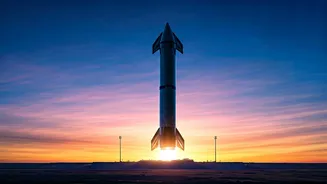
The Starship upper stage, meanwhile, also encountered an engine issue, with one of its six Raptor engines shutting down. The remaining five engines continued to fire for a duration that propelled the vehicle on a suborbital trajectory, nearing a full circumnavigation of the globe. This engine malfunction prevented SpaceX from proceeding with a planned relighting of a Raptor engine in space, a step deemed essential for validating the vehicle's deorbit capabilities. The ability to reliably deorbit an upper stage is a prerequisite for achieving orbital flights and ensuring safe returns. Despite this setback, the upper stage executed another significant in-space objective: successfully deploying 20 Starlink satellite simulators from its payload bay. Additionally, two larger test spacecraft equipped with cameras captured valuable external footage, offering unprecedented views of the stage during its mission.
Reentry and Final Moments
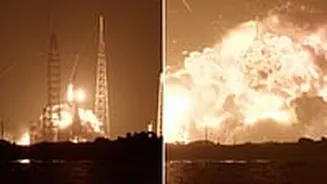
The upper stage of the Starship vehicle then began its fiery descent back into Earth's atmosphere. It demonstrated structural resilience during this intense reentry phase, remaining intact as it navigated a series of maneuvers over the Indian Ocean. To facilitate its controlled landing, two of its Raptor engines were reignited, positioning the vehicle for a planned engines-down water landing. However, upon entering the water, the charred vehicle remained upright for a brief period before toppling over. This instability led to an explosion, creating a striking orange mushroom cloud. This dramatic conclusion highlights the ongoing challenges associated with returning partially fueled stages to Earth, as any leftover propellant can pose a risk of explosion if the vehicle tips over post-landing.
Strategic Importance for SpaceX
This latest launch is particularly significant given SpaceX's strategic goals and its recent public filing for an initial public offering. The company heavily relies on Starship's fully reusable design and its projected payload capacity of over 110 tons to Low Earth Orbit (LEO) to expand its Starlink constellation. Projections indicate that Starship could begin delivering payloads to orbit by the latter half of 2026, potentially deploying up to 60 V3 Starlink satellites per launch, a twenty-fold increase in deployment capacity compared to a Falcon 9 launch. Any delays or failures in scaling Starship's capabilities could significantly impede SpaceX's growth strategy, underscoring the critical nature of these test flights for its future commercial and ambitious space exploration objectives.
NASA's Lunar Ambitions
NASA also has substantial stakes in Starship's development, particularly for its Artemis program. The space agency awarded SpaceX a significant contract, initially $2.9 billion and later revised to $4 billion, to develop a version of Starship's upper stage as a human lunar lander. This collaboration is crucial for future crewed missions to the Moon. While NASA's own Space Launch System (SLS) rocket is progressing, with the Artemis II mission successfully sending astronauts around the Moon, Starship represents a key component for landing humans on the lunar surface. The agency has also diversified its lander development, awarding a contract to Blue Origin in 2023, creating a competitive landscape for lunar landing systems and influencing the architecture and timelines for future Artemis missions.
Evolving Lander Designs
The lunar lander competition has seen shifts, with SpaceX adapting its Starship design following initial concerns. After public exchanges with Elon Musk, SpaceX committed to developing a more streamlined version of its lander to compete with Blue Origin's approach, which also aims for a simpler, smaller lander. NASA's current schedule anticipates an Artemis III mission in low Earth orbit by 2027, where a crewed Orion capsule launched by SLS would rendezvous with either a SpaceX or Blue Origin lander. This highlights the dual-track development strategy NASA is employing to ensure lunar landing capabilities are available, while also managing the complexities of orbital refueling requirements for certain mission architectures, such as SpaceX's initial concept.
Looking Ahead
Despite the partial successes of the Starship test flight, it did not advance the timeline for deploying a Human Landing System upper stage into orbit to the degree SpaceX had hoped. The mission provided invaluable data on the vehicle's performance in various flight regimes, identifying areas that require further engineering attention. The company's ongoing commitment to iterative testing and development, as demonstrated by this flight and the numerous previous tests, is central to its strategy for achieving its ambitious goals. The presence and commentary of figures like NASA Administrator Jared Isaacman during the launch, expressing confidence and anticipation for future rendezvous in Earth orbit, underscore the broad industry support and the shared vision for progressing human space exploration capabilities.