







Demand Outstrips Supply
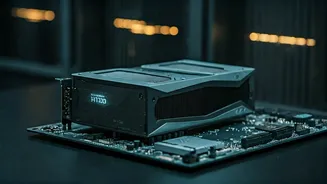
The market for high-performance graphics processing units (GPUs), particularly Nvidia's H100 models, is experiencing unprecedented strain. Rental costs
for these powerful chips have climbed by approximately 40%, escalating from around $1.70 per hour in October to roughly $2.35 per hour, as reported by industry analysis. This surge is not an isolated incident but reflects a broader trend where GPU capacity is almost entirely allocated, with availability being severely limited across the board. Companies that had previously secured access to these resources are reluctant to relinquish them, even as prices continue to climb. Consequently, acquiring available GPUs has become a significant challenge, with some entities resorting to bidding on higher-priced, on-demand instances from cloud providers.
New Chips, Persistent Demand
The scarcity is not confined to older GPU models; even Nvidia's latest Blackwell series is facing extended lead times, pushing availability well into mid-2026. This situation defies initial expectations that the introduction of more advanced and efficient processors would alleviate pressure on existing hardware like the H100. Instead, demand for the H100 has remained robust, or even intensified. This sustained high demand is largely propelled by the burgeoning use of artificial intelligence applications, particularly those focused on generating media content and the widespread adoption of sophisticated language models. The ongoing advancements in AI capabilities are continuously fueling the need for more powerful and readily available processing hardware.
Future Price Determinants
Several key elements will shape whether current high GPU prices persist. Foremost among these is the speed at which new GPU manufacturing capacity can be brought online to meet demand. Additionally, the continuation of broader semiconductor supply chain challenges will play a crucial role. The rate at which AI technologies continue to evolve and their adoption expands will also be a significant factor. Despite these strong underlying market drivers, there's a notable divergence in investor sentiment towards companies specializing in GPU infrastructure, with their stock values hovering near recent lows. This suggests a potential disconnect between the tangible, real-world demand for processing power and the market's expectations regarding future supply dynamics.