


Whale Chatter Decoded
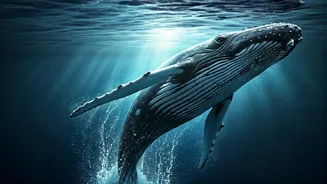
Project CETI is at the forefront of deciphering the complex clicks and whistles of sperm whales, often referred to as 'codas.' These rhythmic sounds are
not random; they form intricate patterns that AI algorithms are now capable of analyzing with remarkable precision. Researchers have achieved an impressive 72% accuracy in predicting whale behavior based on these vocalizations and an even higher 86% for anticipating their future actions. This advanced analysis has revealed a richer communication system than previously understood, with numerous distinct codas that go beyond earlier counts. The AI's ability to crunch these rhythms and patterns allows scientists to discern context-specific meanings, suggesting that complex dialogue is indeed occurring beneath the ocean's surface. This breakthrough could one day enable real-time translations during whale-watching tours, offering insights into cetacean social dynamics and observations about their environment, potentially leading to more profound human-animal interactions.
Nature's Universal Translator
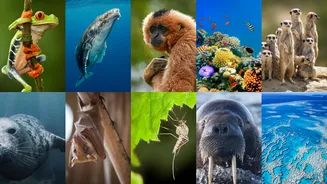
The Earth Species Project is developing the NatureLM-Audio model, a sophisticated AI designed to act as a universal translator for the animal kingdom. This innovative system is trained on the vast datasets of human language and music, enabling it to learn the fundamental structures of communication. By doing so, it can not only identify different animal species based on their vocalizations but also predict their likely responses within their own communication systems. The project emphasizes the critical role of extensive data in achieving significant translation breakthroughs. Unlike simpler recognition systems that might just identify a bird's song, NatureLM-Audio aims to understand the inherent meaning behind these sounds. A key challenge involves filtering out ambient environmental noise while strictly adhering to ethical considerations in its development and application, aiming to revolutionize our understanding of animal communication and potentially transform human relationships with other species.
Dolphin's Word-Like Calls
Marine biologist Dr. Sayigh's groundbreaking research into dolphin communication has revealed sophisticated vocal patterns that exhibit word-like functions. This work, bolstered by a $100,000 grant in May 2025, indicates that dolphins possess a communication system far more complex than previously assumed, moving beyond simple calls to something closer to conversational exchange. The implications of this research are significant, especially in light of a $500,000 challenge offered to any AI system capable of enabling undetected human-animal communication. Such technology could transform ecotourism, allowing for real-time translations during dolphin encounters. This enhanced understanding not only deepens our appreciation for these intelligent marine mammals but also underscores the importance of conservation efforts, providing a powerful tool for fostering respect and protection.
Ethical AI in Nature
As AI delves deeper into understanding animal vocalizations, the need for ethical guidelines becomes paramount. The PEPP framework—Prepare, Engage, Prevent, Protect—serves as a crucial set of principles for policymakers and scientists working in this nascent field. This framework acts as a safeguard, ensuring that AI research into interspecies communication proceeds responsibly and does not inadvertently disrupt the delicate social structures of animal populations. It addresses potential unintended consequences that could arise from technological interference in natural communication systems, such as manipulating bat conversations or elephant herd dynamics. PEPP functions as a responsible overseer, guiding research to advance our knowledge without turning wildlife habitats into uncontrolled communication experiments, thereby promoting a balance between scientific discovery and ecological preservation.