





Telescopes Shine Bright
The year 2025 brought forth significant developments in telescope technology, allowing for deeper and more detailed explorations of the cosmos. Several
telescopes stood out, including the James Webb Space Telescope (JWST), which captured the clearest-ever image of M87 galaxy's supermassive black hole jet. This achievement showcased JWST's exceptional capabilities. Additionally, the Subaru Telescope made its first discoveries, including a 'failed star' and an exoplanet. Furthermore, the construction of the Extremely Large Telescope (ELT) was underway, promising even greater observational power. Moreover, advancements in smart telescope technology allowed both beginners and experienced astronomers to observe stars, galaxies, and nebulas with ease during the holiday season. The use of AI helped fix JWST’s blurry vision, leading to better images of space.
Exoplanet Revelations Galore
2025 unveiled remarkable insights into exoplanets. Astronomers captured close-up images of nova explosions on two dead stars, offering unprecedented detail. The James Webb Space Telescope (JWST) found strong evidence for an atmosphere around a rocky exoplanet, described as similar to a 'wet lava ball.' Discoveries included images of a rare Tatooine-like exoplanet with a strange 300-year orbit, which created quite a buzz, as well as scientists capturing 51 images showcasing exoplanets coming together around other stars. This data set was described as an astronomical treasure. These findings greatly expanded our understanding of planetary systems beyond our own and highlighted the diversity and complexity of the universe. Moreover, the year’s observation helped deepen the understanding of how exoplanets are formed and evolve.
Cosmic Events Unveiled
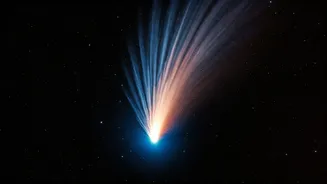
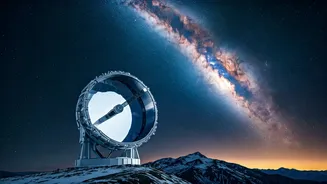
2025 offered spectacular views of cosmic events. The year brought forth mesmerizing images of the Geminid meteor shower, offering opportunities to witness shooting stars. Furthermore, the Large Magellanic Cloud burst with baby stars, capturing the imagination of stargazers worldwide. Moreover, the Milky Way was seen arching over the Very Large Telescope, giving astronomers an amazing experience. Images of Comet Lemmon and the Milky Way over Hawaii also marked the year. The US Space Force installed a 'next level' system to combat drones near Cape Canaveral launch sites. In addition, scientists mapped old Mars river basins, potentially offering insight into the search for ancient life. These events underscored the dynamic and ever-changing nature of the cosmos, providing opportunities to marvel at the universe’s beauty.
Advancements and Innovations
The year saw notable technological advancements, including the development of color-changing, bacteria-infused spacesuits designed to protect future astronauts from space radiation. NASA’s next-gen Roman Space Telescope was surprising scientists with its capabilities even before its launch. These innovations demonstrated the ongoing efforts to enhance space exploration and to keep humans safe in the harsh environment of space. The use of lasers targeting the Tarantula Nebula with 'artificial stars' provided further evidence of the use of new technologies. Moreover, satellite constellations were projected to obscure most space telescope observations by the late 2030s, causing serious concern among astronomers.